Last modified: 2026-03-03 18:58:29 +0900
View History
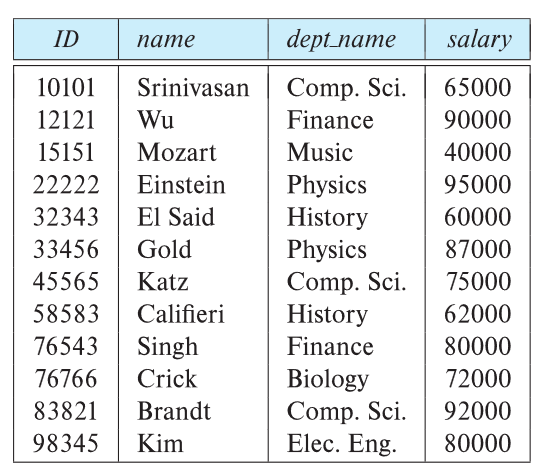
Example of a Instructor Relation
Structure of Relational Databases
A relational database consists of a collection of tables, each of which is assigned a unique name.
In the realational model the term relation is used to refer to a table.
e.g. instructor is a relation(or a table).
While the term tuple is used to refer to a row.
e.g. (10101, Srinivasan, Comp.Sci., 65000) is a tuple.
Similary, the term attribute refers to a column of a table.
e.g. dept_name is a attribute.
Relation Schema and Instacne
$A_1, A_2, ..., A_n$ are attributes.
$R = (A_1, A_2, ..., A_n)$ is a realtional schema.
e.g. instructor = (ID, name, dept_name, salary)
A relational instance r defined over schema R is denoted by r(R).
The current values a relation are specified by a table.
An element t of relation r is called a tuple and is represented by a row in a table.
Attributes
The set of allowed values for each attribute is called the domain of the attribute.
Attribute values are (normally) required to be atomic.
that is, indivisible.
The special value null is a member of every domain.
Indicated that the value is unknown or does not exist.
The null value causes complications in the definition of many operations.
Relations are Unordered
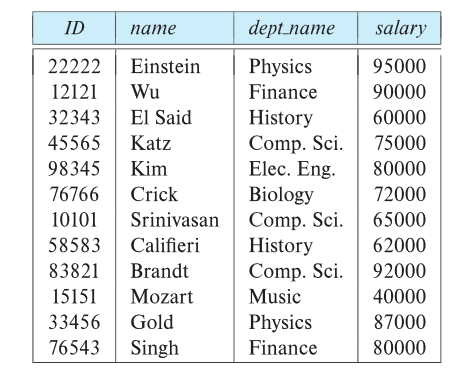
Order of tuples is irrelevant.
tuples may be stored in an arbitrary order.
e.g. instructor relation with unordered tuples.
Database Schema
The concept of a relation corresponds to the programming-language notion of a variable, while the concept of a relation schema corresponds to the programming-language notion of type definition.
Database Schema: The logical structure of the database.
Database Instance: A snapshot of the data in the database at a given instant in time.
Example
schema: instructor(ID, name, dept_name, salary)
Example of a Instance
Keys
Let $K \subseteq R$
K is a superkey of R if values for K are sufficient to identify a unique tuple of each possible relation r(R).
즉, 고유식별자 여부는 column의 내용이 아닌 속성의 정의를 통해 판단
e.g. {ID} and {ID, name} are both superkyes of instructor.
Superky K is a candidate key if K is minimal.
e.g {ID} is a candidate key for instructor.
One of the candidate keys is selected to be the primary key.
Chosen by the database designer.
Primary key constraint
The Primary key constraint uniquely identifies each record in a table.
Primary keys must contain UNIQUE values, and cannot contain NULL values.
A table can have only ONE primary key; and in the table, this primary key can consist of single or multiple columns (fields).
Foreign key constraint: Value in one relation must appear in another
Referencing relation
Referenced relation
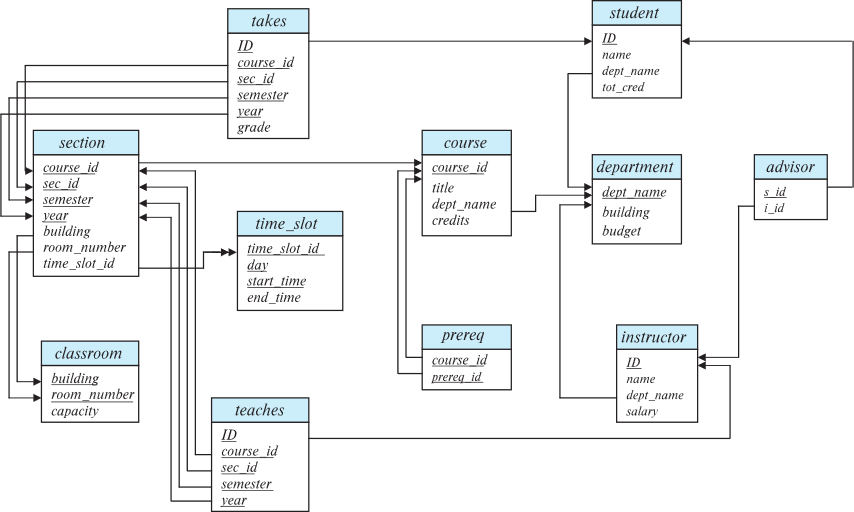
e.g. dept_name in instructor is a foreign key from instructor referencing department.
다음 스키마 다이어그램을 보면, instructor의 dept_name은 department의 dept_name을 참조.
이때, instructor의 dept_name을 외래키라고 함.
참조당하는 쪽(이 경우 department의 dept_name)은 항상 테이블의 primary key여야 함.
instructor측에 null값이 존재하는 경우도 department에 존재하지 않아도 됨.
primary key는 null 값을 가질 수 없기 때문.
Schema Diagrams
A database schema, along with primary key and foregin key constraints, can be depicted by schema diagrams.
Schema Diagram for University Database
Primary key attributes are show underlined.
takes 테이블의 외래키는 2개.
ID
{course_id, sec_id, semester, year}
time_slot 테이블의 time_slot_id는 외래키가 아님.
section 테이블의 time_slot_id를 단순 참조 중.
section 테이블의 time_slot_id이 primary key가 아니기 때문.
Relational Query Languages
A query language is a language in which a user requests information from the database.
Imperative query language: The user instructs the system to perform a specific sequence of operations on the database to compute the desired result.
Such languages usually have a notion of state variables, which are updated in the course of the computation.
Functional query language: The computation is expressed as the evaluation of functions that may operate on data in the database or on the results of other functions.
Functions are side-effect free, and they do not update the program site.
Declarative query language: The user describes the desired information without giving a specific sequence of steps of functions calls for obtaining that information.
The desired information is typically described using some form of mathematical logic.
Procedural versus non-procedural, or declarative
“Pure” languages
Relational algebra
Tuple relational calculus
Domain relational calculus
The above 3 pure languages are equivalent in computing power
We will concentrate in this chapter on relational algebra
Not Turing-machine equivalent
Consists of 6 basic operations
The Realtional Algebra
A procedural language consisting of a set of operations that take one or two relations as input and produce a new relation as their result.
Six basic operators
select: $\sigma$
project: $\Pi$
union: $\cup$
set difference: $-$
Cartesian product: $\times$
rename: $\rho$
Select Operation
The select operation selects tuples that satisfy a given predicate.
Notation: $\sigma_{p}(r)$
p is called the selection predicate.
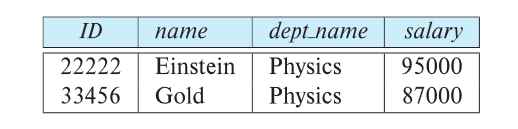
e.g. select those tuples of the instructor relation where the instructor is in the “Physics” department.
$\sigma_{dept \_ name = "Physics"}(instructor)$
Result
We allow compasions using $=, \neq, >, \geq, <, \leq$ in the selection predicate.
We can combine several predicates into a larger predicate by using the connectives.
$\wedge, \vee, \neg$
e.g. find the instructors in Physics with a salary greater $90,000
$\sigma_{dept \_ name = "Physics" \wedge salary > 90000}(instructor)$
The select predicate may include comparisons between two attributes.
e.g. find all departments whose name is the same as their building name
$\sigma_{dept \_ name = building}(department)$
Project Operation
A unary operation that returns its argument relation, with certain attributes left out.
Notation: $\Pi_{A_1, A_2, A_3, ..., A_k}(r)$ where $A_1, A_2, A_3, ..., A_k$ are attribute names and r is a relation name.
The result is defined as the relation of k columns obtained by erasing the columns that are not listed.
Duplicate rows removed from result, since relations are sets
e.g. eliminate the dept_name attribute of instructor
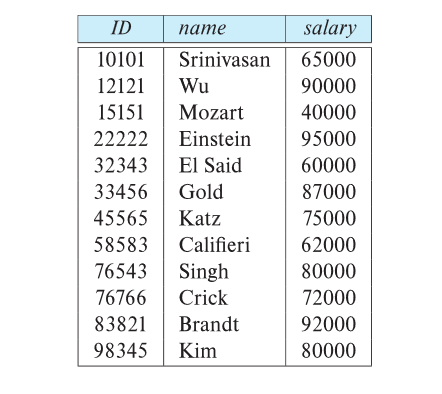
$\Pi_{ID, name, salary}(instructor)$
Result
Composition of Relational Operations
The result of a relational-algebra operation is relation and therefore of relational-algebra operations can be composed together into a relational-algebra expression.
e.g. find the names of all instructors in the Physics department.
$\Pi_{name}(\sigma_{dept \_ name = "Physics"}(instructor))$
Instead of giving the name of a relation as the argument of the projection operation, we give an expression that evaluates to a relation.
Cartesian-Product Operation
The Cartesian-product operation (denoted by $\times$) allows us to combine information from any two relations.
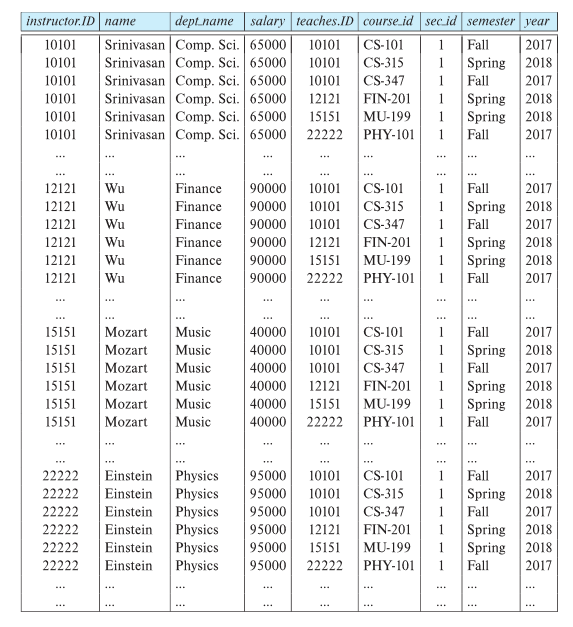
e.g. the Cartesian product of the relations instructor and teaches
$instructor \times teaches$
We construct a tuple of the result out of each possible pair of tuples.
one from the instructor relation and one from the teaches relation.
Since the instructor ID appears in both relations we distinguish between these attribute by attaching to the attribute the name of the relation from which the attribute originally came.
instructor.ID
teaches.ID
The instructor X teaches table
Join Operation
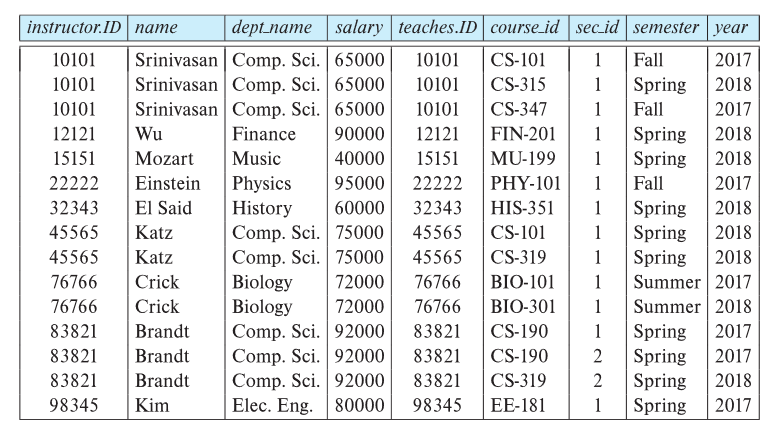
The Cartesian-Product $instructor \times teaches$ associates every tuple of instructor with every tuple of teaches.
Most of the resulting rows have information about instructors who did NOT teach a particular course.
To get only those tuples of “instructor X teaches “ that pertain to instructors and the courses that they taught, we write:
We get only those tuples of “instructor X teaches” that pertain to instructors and the courses that they taught.
Result
The join operation allows us to combine a select operation and a Cartesian-Product operation into a single operation.
Consider relations r(R) and s(S).
Let “theta” be a predicate on attributes in the schema R “union” S
The join operation $r \Join_\theta s$ is defined as follows
$r \Join_\theta s = \sigma_\theta(r \times s)$
Ths, $\sigma_{instructor.id = teaches.id}(instructor \times teaches)$ can equivalently be written as $instructor \Join_{instructor.id = teaches.id} teaches$.
Union Operation
The union operation allows us to combine two realtions.
Notation: $r \cup s$
For $r \cup s$ to be valid
r, s must have the same arity(same number of attributes).
The attribute domains must be compatible.
e.g. Second column of r deals with the same type of values as does the second column of s.
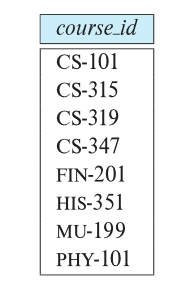
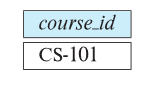
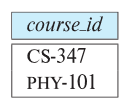
e.g. to find all courses taught in the Fall 2017 semester, or in the Spring 2018 semester, or in both
$\Pi_{course \_ id}(\sigma_{semester = "Fall" \wedge year = 2017}(section)) \cup \Pi_{course \_ id}(\sigma_{semester = "Spring" \wedge year = 2018}(section))$
Result
Set-Intersection Operation
The set-intersection operation allows us to find tuples that are in both the input relations.
Notation: $r \cap s$
Assume
r, s have the same arity.
attributes of r and s are compatible.
e.g. Find the set of all courses taught in both the Fall 2017 and the Spring 2018 semesters.
$\Pi_{course \_ id}(\sigma_{semester = "Fall" \wedge year = 2017}(section)) \cap \Pi_{course \_ id}(\sigma_{semester = "Spring" \wedge year = 2018}(section))$
Result
Set Difference Operation
The set-difference operation allows us to find tuples that are in one relation but are not in another.
Notation: $r - s$
Set differences must be taken between compatible relations.
r and s have the same arity.
attribute domains of r and s must be compatible.
e.g. to find all courses taught in the Fall 2017 semester, but not in the Spring 2018 semester.
$\Pi_{course \_ id}(\sigma_{semester = "Fall" \wedge year = 2017}(section)) - \Pi_{course \_ id}(\sigma_{semester = "Spring" \wedge year = 2018}(section))$
Result
The Assignment Operation
It is convenient at times to write a relational-algebra expression by assigning parts of it to temporary relation variables.
The assignment operation is denoted by $\leftarrow$ and works like assignment in a programming language.
e.g. Find all instructor in the “Physics” and Music department.
$Physics \leftarrow \sigma_{dept \_ name = "Physics"}(instructor)$
$Music \leftarrow \sigma_{dept \_ name = "Music"}(instructor)$
$Physics \cup Music$
With the assignment operation, a query can be written as a sequential program consisting of a series of assignments followed by an expression whose value is displayed as the result of the query.
The Rename Operation
The results of relational-algebra expressions do not have a name that we can use to refer to them. The rename operator, $\rho$ , is provided for that purpose.
The expression: $\rho_x(E)$ returns the result of expression E under the name x.
Another form of the rename operation: $\rho_{x(A1, A2, ..., An)}(E)$
Equivalent Queries
There is more than one way to write a query in relational algebra.
e.g. Find information about courses taught by instructors in the Physics department with salary greater than 90,000.
$\sigma_{dept \_ name = "Physics" \wedge salary > 90000}(instructor)$
$\sigma_{dept \_ name = "Physics"}(\sigma_{salary > 90000}(instructor))$
e.g. Find information about courses taught by instructors in the Physics department.
$\sigma_{dept \_ name = "Physics"}(instructor \Join_{instructor.ID = teaches.ID} teaches)$
$(\sigma_{dept \_ name = "Physics"}(instructor)) \Join_{instructor.ID = teaches.ID} teaches$
The two queries are not identical; they are, however, equivalent.