Overview
- Also known as
- Purpose
- Permits classes with different interfaces to work together by creating a common object by which they may communicate and interact.
- Use When
- A class to be used doesn't meet interface requirements.
Adapters in SW
- You have an existing software system.
- You need to work a new vendor library into, but the new vendor designed their interfaces differently than the last vendor.
- Write a class that adapts the new vendor interface into the one you’re expecting.
Typical working process and Motivation
- Mechanism
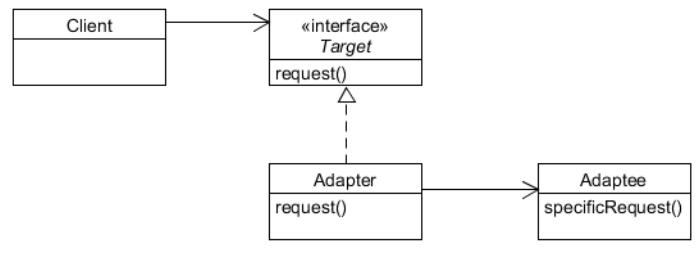
- A client makes a request to the adapter by calling a method on it using the target interface.
- The adapter translates the request into one or more calls on the adaptee using the adaptee interface.
- The client receives the results of the call and never knows there is an adapter doing the translation.
- Motivation
- A toolkit or class library may have an interface which is incompatible with an application’s interface we want to integrate.
- It is possible that we do not have access to the source code of the toolkit or library.
- Even if the source code is available, we may want to minimize the change.
Example
Simplified Duck and Turkey
public interface Duck {
    public void quack ();
    public void fly ();
}

public class MallardDuck implements Duck {
    public void quack () {
        System.out.println(“Quack”);
    }

    public void fly ( ) {
        System.out.println (“I am flying”);
    }
}

public interface Turkey {
    public void gobble ();
    public void fly ( );
}

public class WildTurkey implements Turkey {
    public void gobble ( ) {
        System.out.println(“Gobble Gobble”);
    }

    public void fly ( ){
        System.out.println(“I’m flying a short distance”);
    }
}
Turkey Adapter
public class TurkeyAdapter implements Duck {
Turkey turkey;
    public TurkeyAdapter (Turkey turkey) {
        this.turkey = turkey;
    }

    public void quack () {
        turkey.gobble ();
    }

    public void fly () {
        for (int i= 0; i < 5; i++)
            turkey.fly ();
    }
}
TestDrive
public class DuckTestDrive {
    public static void main(String[] args) {
        MallardDuck duck = new MallardDuck();
        WildTurkey turkey = new WildTurkey();
        Duck turkeyAdapter = new TurkeyAdapter(turkey);
        System.out.println("The Turkey says...");
        turkey.gobble();
        turkey.fly();

        System.out.println("\nThe Duck says...");
        testDuck(duck);
        System.out.println("\nThe TurkeyAdapter says...");
        testDuck(turkeyAdapter);
    }

    static void testDuck(Duck duck) {
        duck.quack();
        duck.fly();
    }
}
Object Adapter v.s. Class Adapter
- Object Adapter: uses object composition and delegation
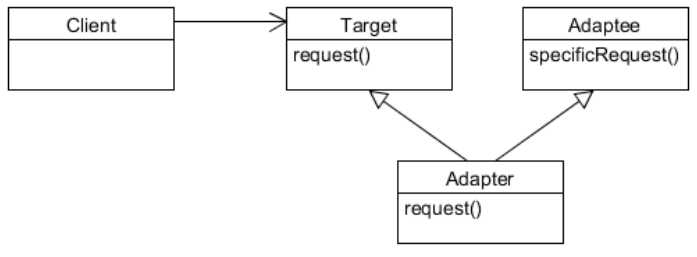
- Class Adapter: uses inheritance
Implementation Issues
- How much adaptation?
- Simple and straightforward interface conversion such as
- Changing method names.
- Changing the order of arguments.
- Totally different set of operations.
- Two-way transparency?
- A two-way adapter supports both the Target and the Adaptee interface.
- It allows an adapted object (Adapter) to appear as an Adaptee object or a Target object.
Enumerators v.s. Iterator
- Enumeration
- Java’s old collection types such as Vector, Stack, HashTable, etc
- hasMoreElements()
- nextElement()
- Iterator
- hasNext()
- next()
- remove()
Adapting Enumeration to Iterator (EnumerationIterator)
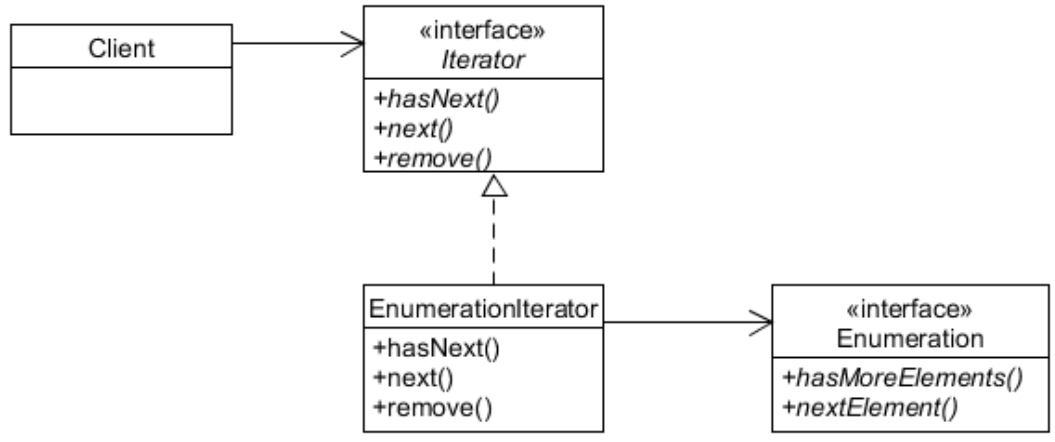
EnumerationIterator Adapter
public class EnumerationIterator implements Iterator {
    Enumeration enum;

    public EnumerationIterator(Enumeration enum) {
        this.enum = enum;
    }

    public boolean hasNext() {
        return enum.hasMoreElements();
    }

    public Object next() {
        return enum.nextElement();
    }

    public void remove() {
        throw new UnsupportedOperationException();
    }
}
Summary
- Adapter pattern
- Converts the interface of a class into another interface clients expect.
- Lets classes work together that couldn’t otherwise because of incompatible interfaces.
- Class adapter and object adapter.