Overview
Purpose
- Encapsulates a request as an object.
- This allows the request to be handled in traditionally object based relationships such as queuing and callbacks.
Use When
- Requests need to be specified, queued, and executed at variant times or in variant orders.
- A history of requests is needed.
- The invoker should be decoupled from the object handling the invocation.
Example
Given Hardware
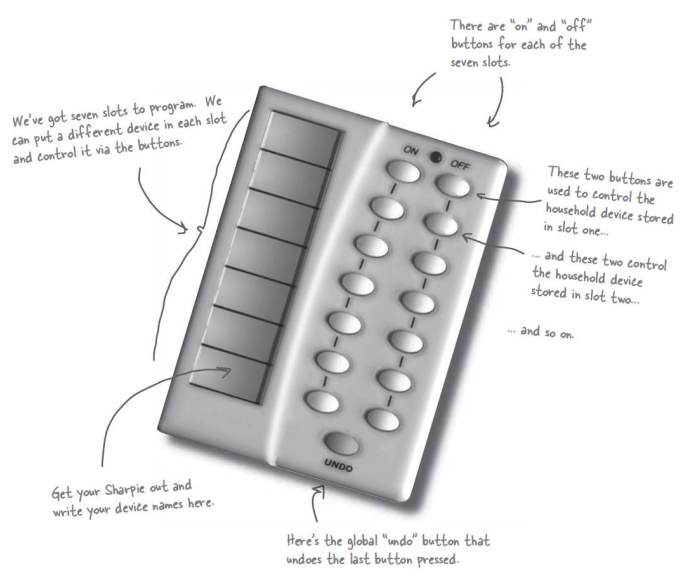
Our Vendor Classes
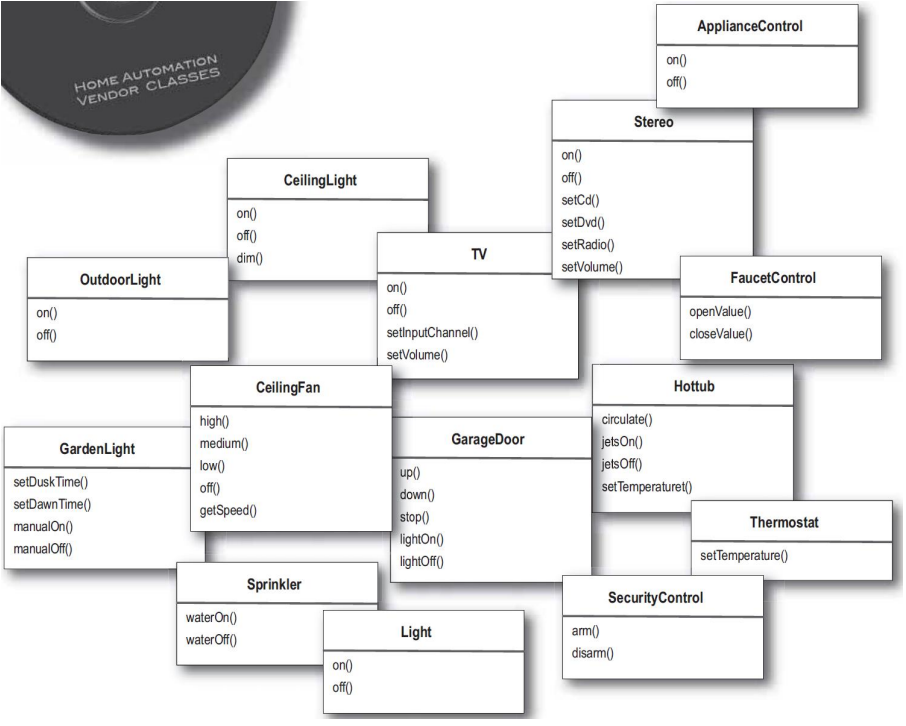
Without Using Command Pattern
if(command == Slot1On)
    light.on();
else if(command == Slot1Off)
    light.off();
- Every time you want to modify the behavior of a button, you need to touch the client code!
Implementing Command interface
public interface Command {
    public void execute();
}
- You may want to include undo() for undo operation later.
Implementing a command
public class LightOnCommand implements Command {
Light light;
public LightOnCommand(Light light) {
this.light = light;
}
public void execute() {
light.on();
}
}
Using the command object (Building Invoker)
public class SimpleRemoteControl {
    Command slot;

    public SimpleRemoteControl() {}

    public void setCommand(Command command) {
        slot = command;
    }

    public void buttonWasPressed(){
        slot.execute();
    }
}
Client Program
public class RemoteControlTest {
    public static void main(String[] args) {
        SimpleRemoteControl remoteControl = new SimpleRemoteControl();

        Light light = new Light();
        LightOnCommand lightOn = new LightOnCommand(light);

        remote.setCommand(lightOn);
        remote.buttonWasPressed();
    }
}
public class SimpleRemoteControl {
    Command slot;
    public void buttonWasPressed(){
        slot.execute();
    }
}
public class LightOnCommand implements Command {
    Light light;
    public void execute() {
        light.on();
    }
}
Command Pattern
- LightOn, LightOff, TVOn, TVOff, etc.
public class LightOffCommand implements Command {
Light light;
public LightOffCommand(Light light) {
this.light = light;
}
public void execute() {
light.off();
}
}
- Command Pattern encapsulates a request as an object.
- Each command object exposes only execute (and undo) method.
Our Approach
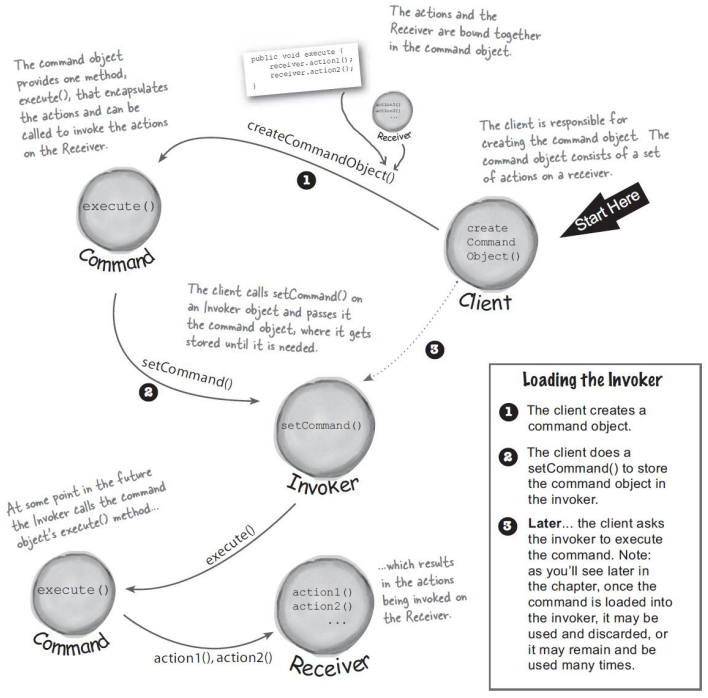
- Encapsulates a request as an object
- Thus, let you parameterize clients with different requests, queue or log requests, and support undoable operations.
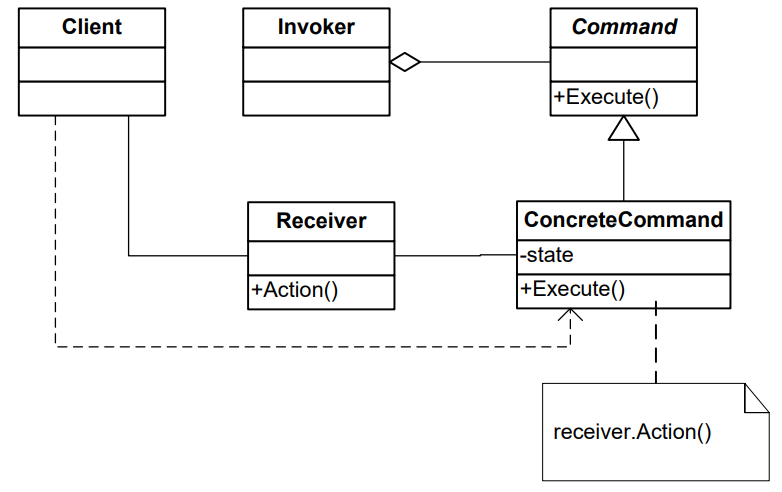
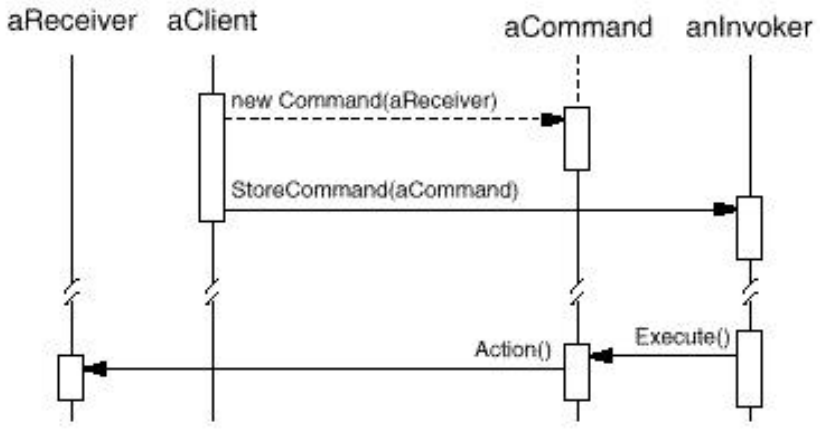
Collaborations
Extending the Remote Control
public class RemoteControl {
Command[] onCommands;
Command[] offCommands;
RemoteControl() {
onCommands = new Command[7];
offCommands = new Command[7];
Command noCommand = new NoCommand();
for(int i = 0; i < 7; ++i) {
onCommands[i] = noCommand;
offCommands[i] = noCommand;
}
}
}
public class NoCommand implements Command {
public void execute() {}
}
Command Pattern
public void setCommand(int slot, Command onCommand, Command offCommand) {
    onCommands[slot] = onCommand;
    onCommands[slot] = offCommand;
}

public void onButtonWasPushed (int slot) {
    onCommands[slot].execute();
}

public void offButtonWasPushed (int slot) {
    offCommand[slot].execute();
}
Client Program
public class RemoteLoader {
public static void main(String[] args) {
RemoteControl remotecontrol = new RemoteControl();
Light livingRoomLight = new Light("Living Room");
Light kitchenLight = new Light("Kitchen");
Command livingRoomLightOn = new LightOnCommand(livingRoomLight);
Command livingRoomLightOff = new LightOffComman(livingRoomLight);
Command kitchenlightOn = new LightOnCommand(kitchenLight);
Command kitchenlightOff = new LightOffCommand(kitchenLight);
remotecontrol.setCommand(0,livingRoomLightOn,livingRoomLightOff);
remotecontrol.setCommand(1,kitchenlightOn,kitchenlightOff);
remotecoltrol.onButtonWasPushed(0);
remotecoltrol.offButtonWasPushed(0);
remotecoltrol.onButtonWasPushed(1);
remotecoltrol.offButtonWasPushed(1);
}
}
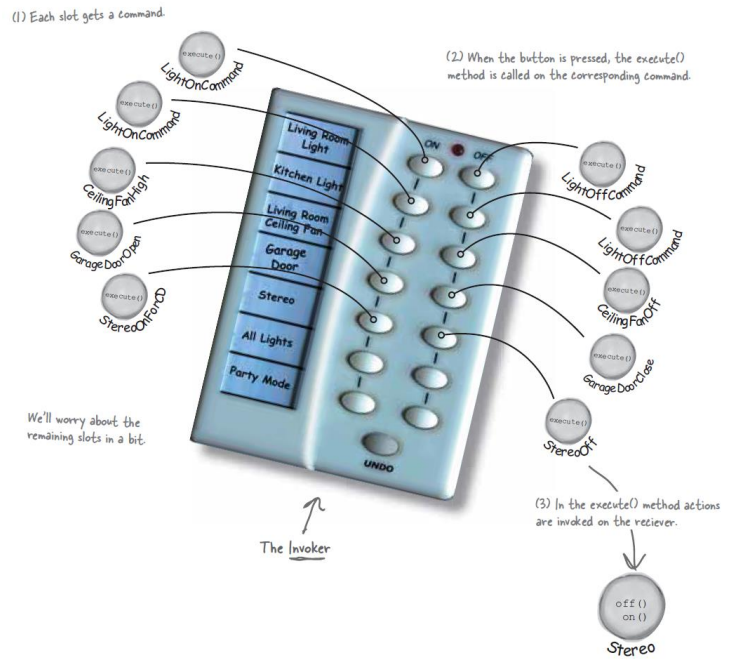
After Setting the Commands
Supporting Undo
public class LightOnCommand implements Command {
    Light light;
    public LightOnCommand(Light light){
        this.light = light;
    }

    public void execute() {
        light.on();
    }

    public void undo() {
        light.off();
    }
}

public void onButtonWaspressd(int slot) {
    onCommands[slot].execute();
    undoCommand = onCommands[slot];
}

public void offButtonWaspressd(int slot){
    offCommands[slot].execute();
    undocommand = offCommands[slot];
}

public void undoButtonWaspressd(){
    undocommand.undo();
}
Supporting Macro Commands
public class MacroCommand implements Command {
    Command[] command;

    public MacroCommand(Command[] command){
        this.command = command;
    }

    public void execute(){
        for(int i = 0; i < command.length; i++)
            command[i].execute();
    }
}
Command + Iterator
public class MacroCommand implements Command {
ArrayList <Command>commands;
public MacroCommand(Command[] commands) {
this.commands = new ArrayList();
for (int i=0; i< commands.length; i++)
this.commands.add(commands[i]);
}
public void execute() {
for (Command item: this.commands)
item.execute();
}
public void undo() {
ListIterator<Command> i=commands.listIterator(commands.size());
while (i.hasPrevious())
i.previous().undo();
}
}
Active Object Pattern
interface Command {
    public void execute();
}

class ActiveObjectEngine {
    LinkedList itsCommands = new LinkedList();

    public void addCommand(Command c) {
        itsCommands.add(c);
    }

    public void run() {
        while (!itsCommands.isEmpty()) {
            Command c = (Command) itsCommands.getFirst();
            itsCommands.removeFirst();
            c.execute();
        }
    }
}

class SleepCommand implements Command {
    private Command wakeupCommand = null;
    private ActiveObjectEngine engine = null;
    private long sleepTime = 0; private long startTime = 0;
    private boolean started = false;

    public SleepCommand(long milliseconds, ActiveObjectEngine e, Command wakeupCommand) {
        sleepTime = milliseconds;
        engine = e;
        this.wakeupCommand = wakeupCommand;
    }

    public void execute() {
        long currentTime = System.currentTimeMillis();

        if (!started) {
            started = true;
            startTime = currentTime;
            engine.addCommand(this);
        } else if ((currentTime - startTime) < sleepTime ) {
            engine.addCommand(this);
        } else
            engine.addCommand(wakeupCommand);
    }
}

public class DelayedTyper implements Command {
    private long mDelay = 0;
    private char mChar;
    private static boolean stop = false;
    private static ActiveObjectEngine engine = new ActiveObjectEngine();

    public DelayedTyper(long delay, char c) {
        mDelay = delay;
        mChar = c;
    }

    @Override
    public void execute() {
        System.out.print(mChar);

        if (!stop) delayAndRepeat();
    }

    private void delayAndRepeat() {
        engine.addCommand(new SleepCommand(mDelay, engine, this));
    }

    public static void main(String args[]) throws Exception {
        engine.addCommand(new DelayedTyper(100, '1'));
        engine.addCommand(new DelayedTyper(300, '3'));
        engine.addCommand(new DelayedTyper(500, '5'));
        engine.addCommand(new DelayedTyper(700, '7'));

        Command stopCommand = new Command() {
            @Override public void execute() {
                stop = true;
            }
        };

        engine.addCommand(new SleepCommand(10000, engine, stopCommand));
        engine.run();
    }
}
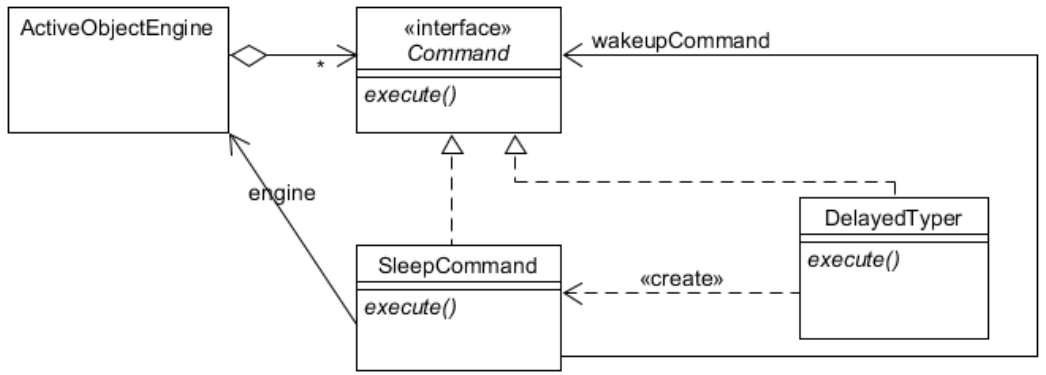
Class Diagram for DelayedTyper
Review
- Command decouples the object that invokes the operation from the one that knows how to perform it.
- Commands can be manipulated and extended like any other object.
- You can assemble commands into a composite command.
- E.g. MacroCommand class
- In general, composite commands are an instance of Composite pattern