Overview
- Purpose
- Supplies a single interface to a set of interfaces within a system.
- Use When
- A simple interface is needed to provide access to a complex system.
- There are many dependencies between system implementations and clients.
- Systems and subsystems should be layered.
The Facade Pattern
- Provides a unified interface to a set of interfaces in a subsystem.
- It defines a higher-level interface that makes a subsystem easier to use.
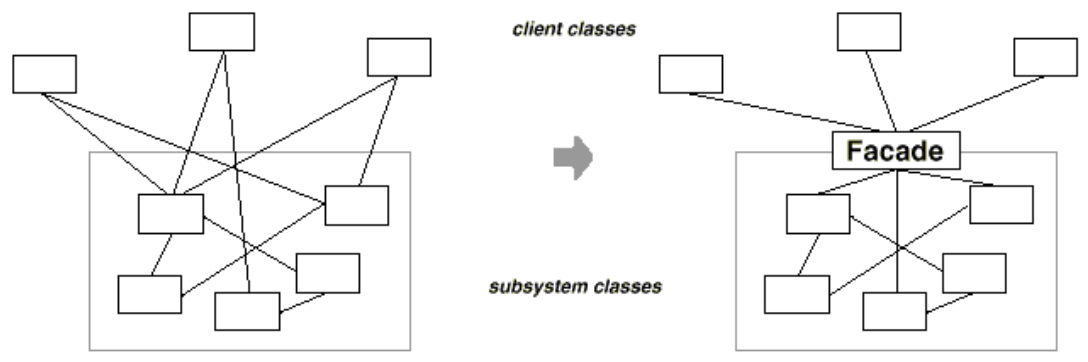
Motivation
- In typical OO Design,
- Structuring a system into subsystems helps reduce complexity.
- Subsystems are groups of classes, or groups of classes and other subsystems.
- May produces many minimal classes.
- Problems
- Class/Subsystem interface can become quite complex.
- A new-comer cannot figure out where to begin.
- Solution
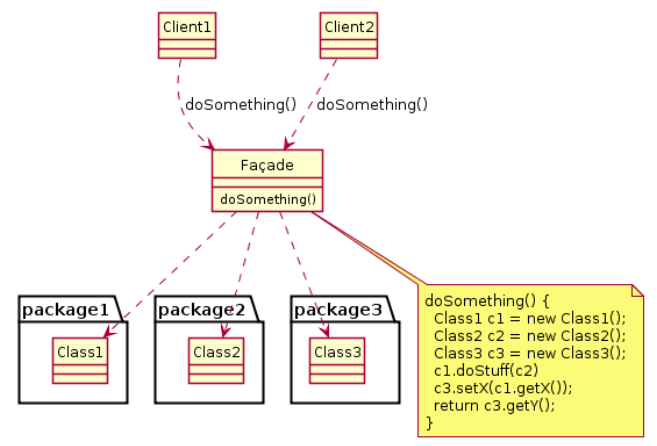
- Facade object provides a single, simplified interface to the more general facilities of a subsystem.
Benefits
- Hides the implementation of the subsystem from clients.
- makes the subsystem easier to use.
- Promotes weak coupling between the subsystem and its clients.
- allows changing the classes comprising the subsystem without affecting the clients.
- Does not prevent sophisticated clients from accessing the underlying classes.
- Notice: Facade does not add any functionality, it just simplifies interfaces.
Example
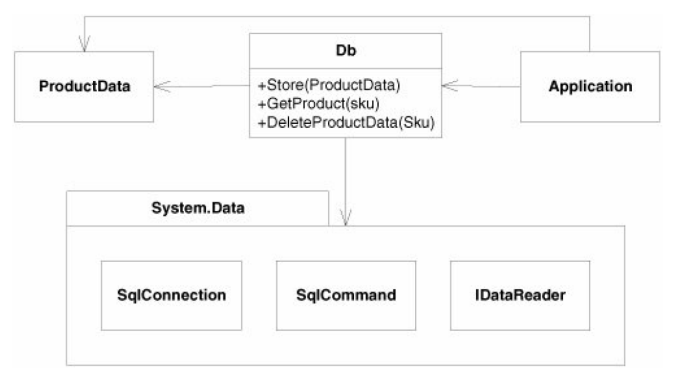
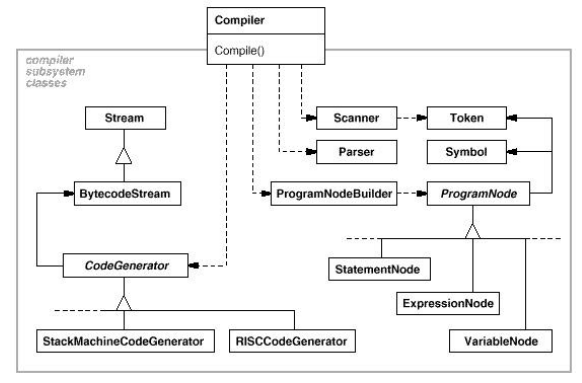
Example Code
class Scanner {...};
class Parser {...};
...
class CodeGenerator {...};
class Compiler {
public:
Compiler();
virtual void Compile(istream&, BytecodeStream&);
};
void Compiler::Compile(istream& input, BytecodeStream& output) {
Scanner scanner(input);
ProgramNodeBuilder builder;
Parser parser;
parser.Parse(scanner, builder);
RISCCodeGenerator generator(output);
ProgramNode* parseTree = builder.GetRootNode();
parseTree->Traverse(generator);
}
Facade Example
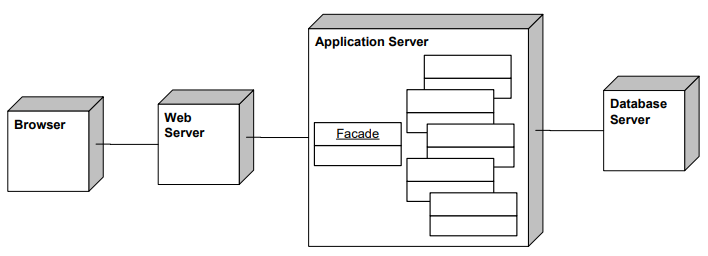
Known Uses: Web Applications
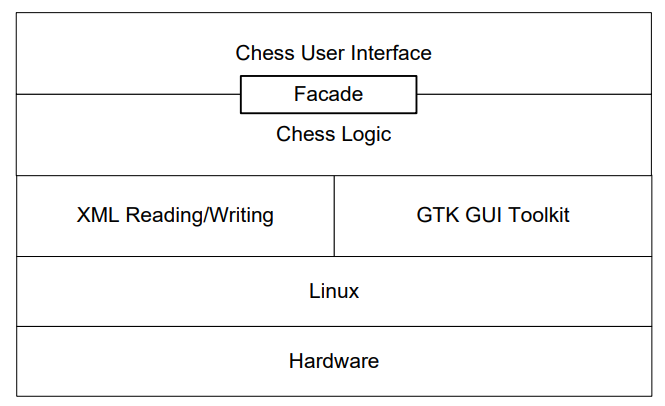
Facade in Layered Architecture
Comparing the Facade with the Adapter Pattern
- Are there existing classes?
- Is there an interface we must design to?
- Is a simpler interface needed?
The Principle of Least Knowledge (Law of Demeter)
- When you design a system, you should be careful of the number of classes it interacts with and also how it comes to interact with those classes.
- A method m of an object o may only invoke the methods of the following kinds of objects.
- o itself
- m's parameters
- any objects created/instantiated within m
- o's direct component objects
- a global variable, accessible by o, in the scope of m
- i.e., "use only one dot"
- a.b.Method() breaks the law where a.Method() does not
Example
public float WorseExample() {
    Thermometer thermometer = station.GetThermometer();
    return thermometer.GetTemperature();
}

public float BetterExample() {
    return station.GetTemperature();
}

public class Car {
Engine engine;
public Car() {
}
public void start(Key key) {
Doors doors = new Doors();
boolean authorized = key.turns();
if (authorized) {
engine.start();
updateDashboardDisplay();
}
}
public void updateDashBoardDisplay() {
}
}
Review
- Provides a unified interface to a set of interfaces in a subsystem.
- Facade defines a higher-level interface that makes the subsystem easier to use.
- Mediator
- Mediator’s colleagues are aware of Mediator.
- Facade
- Unidirectional rather than cooperative interactions between object and subsystem.
- The subsystem doesn’t know about the Facade.
- Facade doesn’t add functionality, Mediator does.