Overview
Creating Objects
- Coding to an interface.
Duck duck = new MallardDuck();
Duck: interface
MallardDuck: concrete class
Needs different ducks depeding on the condition.
Duck duck;

if (picnic) duck = new MallardDuck();
else if (hunting) duck = new DecoyDuck();
else if (inBathTub) duck = new RubberDuck();
- But “new” operator needs Concrete Class.
Factory Patterns
- Creational patterns
- Allow to creating new objects without explicitly using the new operator.
- We can instantiate different objects without modifying client code.
- Examples: Factory Method, Abstract Factory, Singleton, Builder, Prototype
- Factory Method
- Uses inheritance to decide the object to be instantiated.
- Abstract Factory
- Delegates object creation to a factory object.
Example
Original Code
Pizza orderPizza(String type) {
    Pizza pizza;
    if (type.equals("cheese"))
        pizza = new CheesePizza();
    else if (type.equals("greek"))
        pizza = new GreekPizza();
    else if (type.equals("pepperoni"))
        pizza = new PepperoniPizza();

    pizza.prepare();
    pizza.bake();
    pizza.cut();
    pizza.box();

    return pizza;
}
Pizza types are changing!
Pizza orderPizza(String type) {
Pizza pizza;
if (type.equals("cheese"))
    pizza = new CheesePizza();

// changed
else if (type.equals("clam"))
    pizza = new ClamPizza();
else if (type.equals("pepperoni"))
    pizza = new PepperoniPizza();

    pizza.prepare();
    pizza.bake();
    pizza.cut();
    pizza.box();

    return pizza;
}
Building a Simple Factory
public class SimplePizzaFactory {
    public Pizza createPizza(String type) {
        Pizza pizza;
        if (type.equals("cheese"))
            pizza = new CheesePizza();
        else if (type.equals("greek"))
            pizza = new GreekPizza();
        else if (type.equals("pepperoni"))
            pizza = new PepperoniPizza();

        return pizza;
    }
}
Revising PizzaStore class using the Simple Factory
pubilc class PizzaStore {
    SimplePizzaFactory factory;

    public PizzaStore(SimplePizzaFactory factory) {
        this.factory = factory;
    }

    public Pizza orderPizza(String type) {
        Pizza pizza;
        pizza = factory.createPizza(type); // use SimplePizzaFactory

        pizza.prepare();
        pizza.bake();
        pizza.cut();
        pizza.box();

        return pizza;
    }
}
- It looks like we are just pushing the problem off to another object.
Simple Factory (not an official pattern)
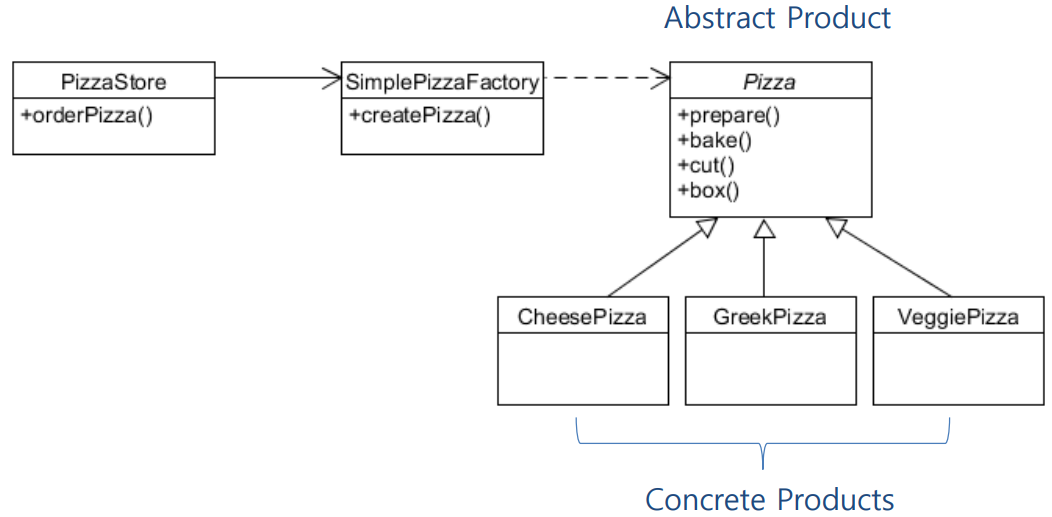
Franchising the pizza store
- Different styles
- NY, Chicago, California, etc
- Different pizza factories
- NYPizzaFactory, ChicagoPizzaFactory, CaliforniaPizzaFactory
NYPizzaFactory nyFactory = new NYPizzaFactory();
PizzaStore nyStore = new PizzaStore(nyFactory);
nyStore.order(“Veggie”);

ChicagoPizzaFactory chicagoFactory = new ChicagoPizzaFactory();
PizzaStore chicagoStore = new PizzaStore(chicagoFactory);
chicagoStore.order(“Veggie”);
Factory Method Pattern
- Purpose
- Exposes a method for creating objects, allowing subclasses to control the actual creation process.
- Use When
- A class will not know what classes it will be required to create.
- Subclasses may specify what objects should be created.
- Parent classes wish to defer creation to their subclasses.
Requirement Change
- Now we need want to make a framework which ties the store and the pizza creation.
public abstract class PizzaStore {
    public Pizza orderPizza(String type) {
        Pizza pizza;
        pizza = createPizza(type);

        pizza.prepare();
        pizza.bake();
        pizza.cut();
        pizza.box();

        return pizza;
    }

    protected abstract Pizza createPizza(String type);
}
Factory Method
- The example is a OO framework providing service “prepare pizza”.
- The framework invokes the createPizza() factory method to create a pizza that it can prepare using a well-defined, consistent process.
- A “client” of the framework will subclass this class and provide an implementation of the createPizza() method.
- Any dependencies on concrete “product” classes are encapsulated in the subclass.
Allowing the subclasses to decide
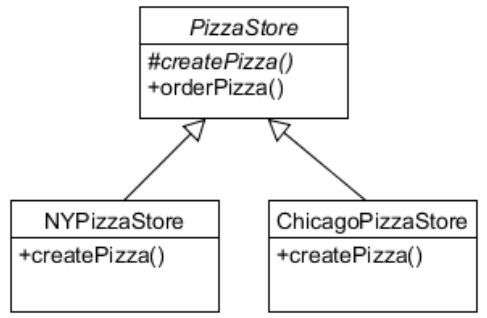
// NYPizzaStore
public Pizza createPizza(String type) {
    Pizza pizza;
    if (type.equals(“cheese”)) {
        pizza = new NYStyleCheesePizza();
    } else if (type.equals(“veggie”)) {
        pizza = new NYStyleVeggiePizza();
    }

    return pizza;
}
// ChicagoPizzaStore
public Pizza createPizza(String type) {
    Pizza pizza;
    if (type.equals(“cheese”)) {
        pizza = new ChicagoStyleCheesePizza();
    } else if (type.equals(“veggie”)) {
        pizza = new ChicagoStyleVeggiePizza();
    }
    return pizza;
}
Ordering a pizza using the Factory Method
- Need an instance of PizzaStore.
PizzaStore nyPizzaStore = new NYPizzaStore(); - Call orderPizza().
nyPizzaStore.orderPizza(“cheese”); - orderPizza() calls createPizza().
Pizza pizza = createPizza(“cheese”); - orderPizza() now prepare, bake, cut and box the pizza.
pizza.prepare();
pizza.bake();
pizza.cut();
pizza.box();
Implementing Pizza class
public abstract class Pizza {
    String name;
    String dough;
    String sauce;

    ArrayList toppings = new ArrayList();

    void prepare(){
        System.out.println(“Preparing “ + name);
        System.out.println(“Tossing dough...”);
        System.out.println(“Adding sauce...”);
        System.out.println(“Adding toppings: “);

        for (int i = 0; i < toppings.size(); i++)
            System.out.println(“ “ + toppings.get(i));
    }

    void bake(){
        System.out.println(“Bake for 25 minutes at 350”);
    }

    void cut(){
        System.out.println(“Cutting the pizza into diagonal slices”);
    }

    void box(){
        System.out.println(“Place pizza in official PizzaStore box”);
    }
}
Subclasses of Pizza
public class NYStyleCheesePizza extends Pizza {
    public NYStyleCheesePizza(){
        name = “NY Style Sauce and Cheese Pizza”;
        dough = “Thin Crust Dough”;
        sauce = “Marinara Sauce”;
        toppings.add(“Grated Reggiano Cheese”);
    }
}

public class ChicagoStyleCheesePizza extends Pizza {
    public ChicagoStyleCheesePizza(){
        name = “Chicago Style Deep Dish and Cheese Pizza”;
        dough = “Extra Thick Crust Dough”;
        sauce = “Plum Tomato Sauce”;
        toppings.add(“Shredded Mozzarella Cheese”);
    }

    void cut(){
        System.out.println(“Cutting the pizza into square slices”);
    }
}
Test Drive
public class PizzaTestDrive {
    public static void main(String[] args){
        PizzaStore nyStore = new NYPizzaStore();
        PizzaStore chicagoStore = new ChicagoPizzaStore();

        Pizza pizza = nyStore.orderPizza(“cheese”);
        System.out.println(“Ethan ordered a “ + pizza.getName());

        Pizza pizza = chicagoStore.orderPizza(“cheese”);
        System.out.println(“Joel ordered a “ + pizza.getName());
    }
}
Applying Factory Method Pattern
- The Factory Method pattern encapsulates object creation by letting subclasses decide what objects to create.
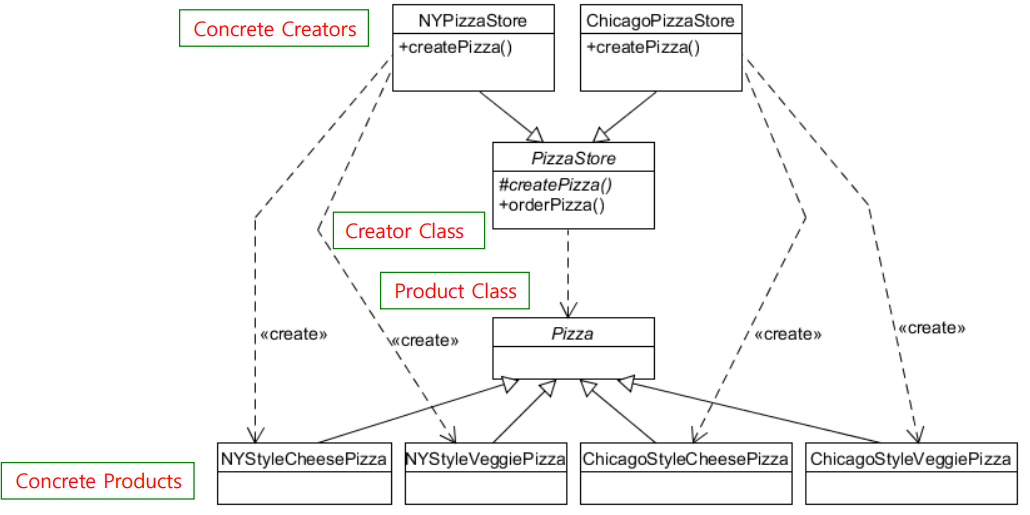
Factory Method Pattern
- Defines an interface for creating an object, but lets subclasses decide which class to instantiate.
- Factory Method lets a class defer instantiation to subclasses.
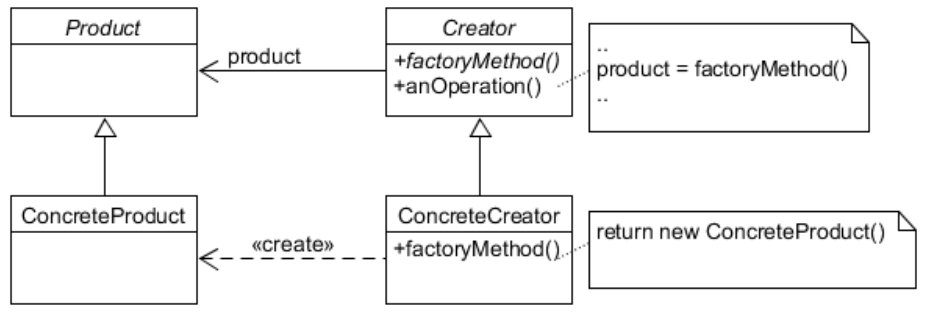
A very dependent PizzaStore (bad design)
public class DependentPizzaStore {
    public Pizza createPizza(String style, String type) {
        Pizza pizza = null;

        if (style.equals("NY")) {
            if (type.equals("cheese")) {
                pizza = new NYStyleCheesePizza();
            } else if (type.equals("veggie")) {
                pizza = new NYStyleVeggiePizza();
            }
        } else if (style.equals("Chicago")) {
            if (type.equals("cheese")) {
                pizza = new ChicagoStyleCheesePizza();
            } else if (type.equals("veggie")) {
                pizza = new ChicagoStyleVeggiePizza();
            }
        } else {
            System.out.println("Error: invalid type of pizza");
            return null;
        }

        pizza.prepare();
        pizza.bake();
        pizza.cut();
        pizza.box();

        return pizza;
    }
}
Dependent PizzaStore VS Factory Method
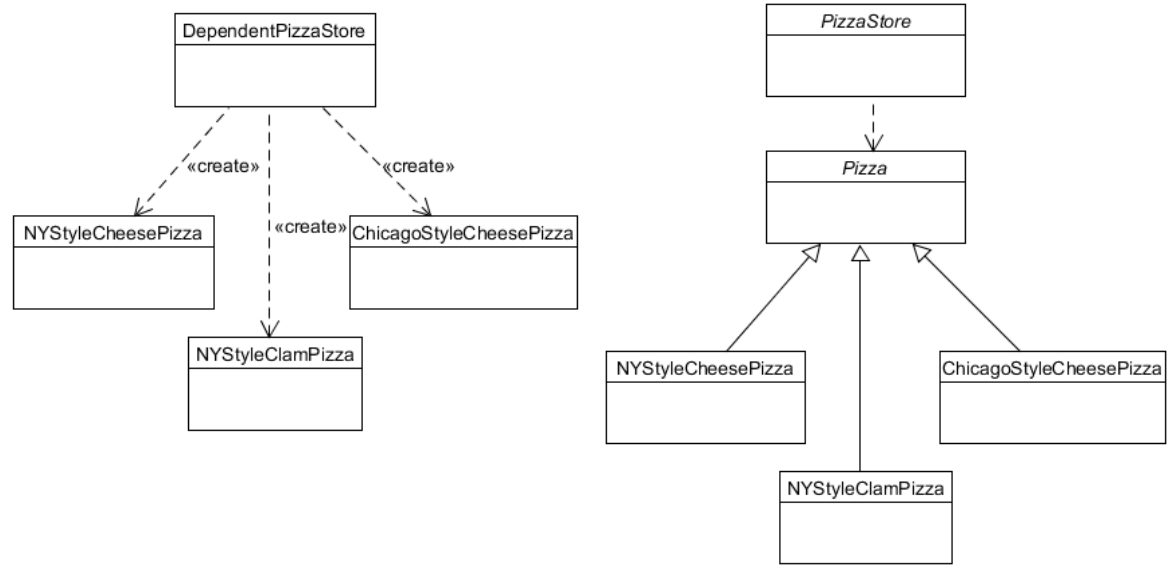
Design Principle: Dependency Inversion Principle
- Dependency Inversion Principle
- Depend upon abstractions. Do not depend upon concrete classes.
- High-level components should not depend on low-level components.
- Rather, they should both depend on abstractions
- Factory Method is one way of following the dependency inversion principle.
Factory Method Pattern
- What exactly does it mean by saying that “the Factory Method Pattern lets subclasses decide which class to instantiate?”
- Creator class is written in such a fashion that it does not know what actual Concrete Product class will be instantiated.
- The Concrete Product class to be instantiated is determined solely by which Concrete Creator subclass is instantiated and used by the application.
- It does not mean that the subclass decides at runtime which ConcreteProduct class to create.