Single Responsibility Principle (SRP)
A class should have one, and only one, reason to change
The Single Responsibility Principle
- Responsibility
- A contract or obligation of a class
- reason to change
- More responsibilities = More likelihood of change
- The more a class changes, the more likely we will introduct bugs
- Change can impact the others
- SRP: Separate coupled responsibilities into separate classes
- Realted measure: Cohesion how strongly-realted and foucused are the various responsibilities of a module
Example
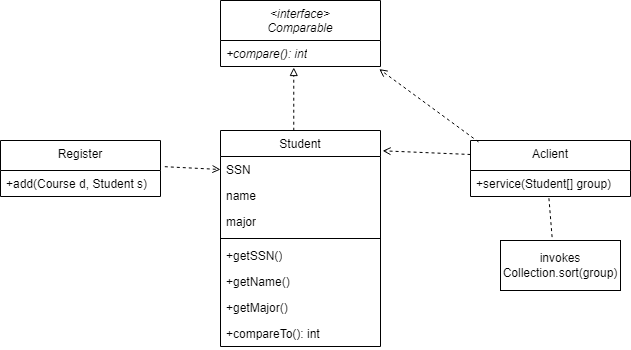
- Often we need to sort students by their name, or SSN. So one may make Class Student implement the Java Comparable interface.
- Student is a business entity, it does not know in what order it should be sorted since the order of sorting is imposed by the client of Student.
- When a new requirement needs to sort students in a different order, Student, Register, and AClient all need to be recompiled, even though Register has nothing to do with any ordering of Students.
- Worse: every time students need to be ordered differently, we have to recompile Student and all its client.
- Cause of the problems: we bundled two separate responsibilities (i.e., student as a business entity with ordering) into one class – a violation of SRP
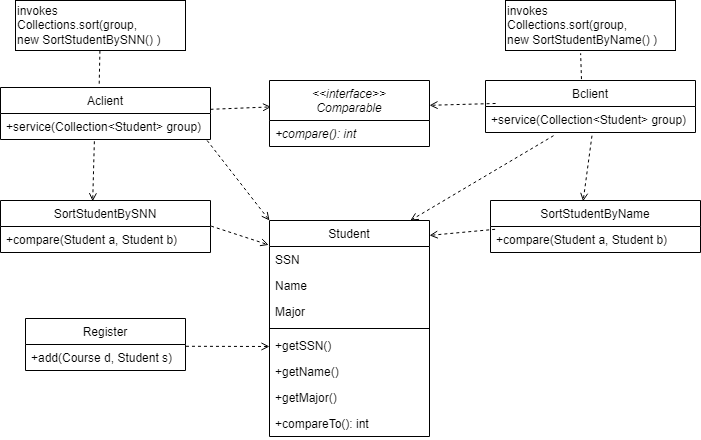
- The solution is to separate the different responsibilities into two separate classes and use another version of Collections.sort().
Another Example
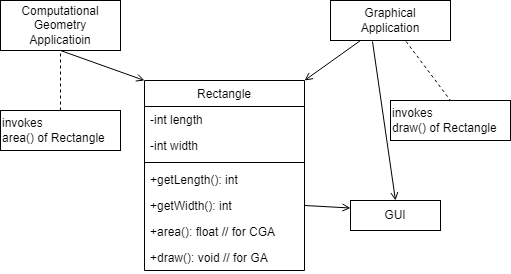
- Class Rectangle may be forced to make changes from two different unrelated sources
- One is from the Computational Geometry Application (CGA). E.g., modifying area().
- The other is from Graphical Application (GA). E.g., modifying draw() for different platforms.
- A change from either of the two source would still cause the other application to recompile.
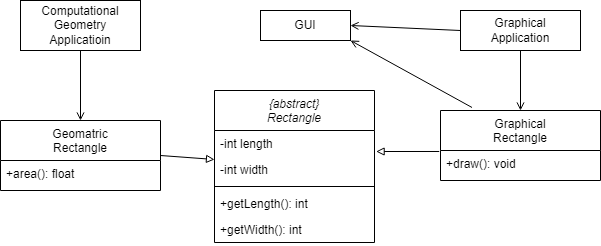
- Package CGA is no longer dependent on graphical side of Rectangle and thus it becomes independent of package GUI.
- Any change caused by graphical application no longer requires CGA to be recompiled.
- Class Rectangle contains the most primitive attributes and operations of rectangles.
- Classes GeometricRectangle and GraphicRectangle are independent of each other. *A change from either side of CGA or GA, it would not cause the other side to be recompiled.
Identifying Responsibilities Can be Tricky
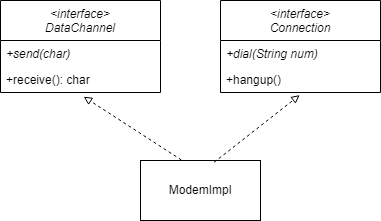
- Two responsibilities: Connection management and Data communication.
- Lesson: It depends on how the application is changing.
- Beware: Avoid Needless Complexity
- If there is no symptom, it is not wise to apply the SRP or any other principle.
Open Closed Principle (OCP)
Software entities (classes, modules, functions, etc.) should be open for extension but closed for modification
- You should be able to extend a class’s behavior, without modifying it.
Conforming to OCP
- Open for extension
- Behavior of the module can be extended
- We are able to change what the module does
- Closed for modification
- Extending behavior does not result in excessive modification such as architectural changes of the module
- Violation Indicator: Design Smell of Rigidity
- A single change to a program results in a cascade of changes to dependent modules.
Example
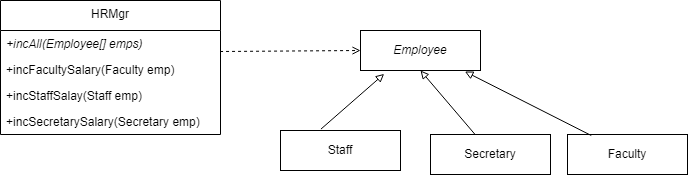
void incAll(Employee[] emps) {
    for (int i = 0; i < emps.size(); i++) {
        if (emps[i].empType == FACULTY)
            incFacultySalary((Faculty)emps[i]);
        else if (emps[i].empType == STAFF)
            incStaffSalary((Staff)emps[i]);
        else if (emps[i].empType == SECRETARY)
            incSecretarySalary((Secretary)emps[i]);
    }
}
- Rigid
- Adding new employee type requires significant changes.
- Fragile
- Many switch/case or if/else statements.
- Hard to find and understand.
- Immobile
- To reuse incAll( ) → we need Faculty, Staff, Secretary, too!
- What if we need just Faculty and Staff only?
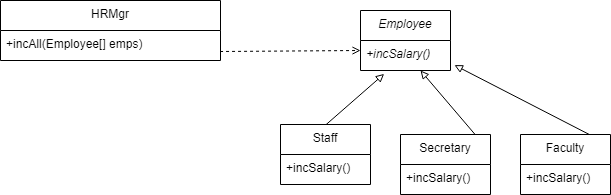
void incAll(Employee[] emps) {
    for (int i = 0; i < emps.size(); i++)
        emps[i].incSalary();
}
- When Engineer is added, incAll() does not even need to recompile.
- This design is open to extension, closed for modification.
Abstraction is the Key
- Abstractions
- Fixed and yet represent an unbounded group of possible behaviors.
- Abstract base class : fixed
- All the possible derived classes : unbounded group of possible behaviors.
- Program the class to interfaces (or abstract classes) not to implementation (concrete classes).
Anticipating Future Changes
- Strategy is needed
- Choose the kinds of changes against which to close design.
- Guess the most likely kinds of changes, and then construct abstractions to protect him from those changes.
- Beware: Consider the cost
- Conforming to OCP is expensive.
- Time and effort to create appropriate abstractions.
- Abstractions also increase complexity.
- Do not put hooks in for changes that might happen.
- "Fool me once, shame on you. Fool me twice, shame on me."
- Initially write the code expecting it to not change.
- When a change occurs, implement the abstractions that protect from future changes of that kind.
- It's better to take the first hit as early as possible.
- We want to know what kind of changes are likely before going too far in the development.
- Use TDD and listen to the tests.
Liskov Substitution Principle (LSP)
Subtypes must be substitutable for their base type
- Derived classes must be substitutable for their base classes.
Liskov Substitution Principle
- A rule that you want to check when you decide to use inheritance or not.
- If C is a subtype of P, then objects of type P may be replaced with objects of type C without altering any of the desirable properties of the program.
Subtyping VS Implementation Inheritance
- Subtyping
- establishes an IS_A relationship
- also known as interface inheritance
- Implementation Inheritance
- only reuses implementation and establishes a syntactic relationship not necessarily a semantic relationship
- Also known as code inheritance
- Most OOP languages like Java, C++, and C#, inheritance keyword such as “extends” does the both Subtyping and Implementation Inheritance
- But some languages distinguish them
The Liskov Substitution Principle and Reuse
- Think twice when you decide to use Inheritance.
- If you want to reuse implementation of List, you had better exploit object composition, not inheritance.
- If you inherit Queue from List, then you violate LSP since Queue object cannot be substitutable for List.
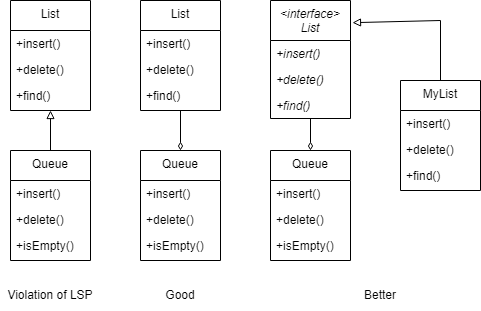
Violation of LSP may lead to another violation
- Assume that when CType is passed to f() instead of PType, it causes f to misbehave.
- it means that CType violates the LSP
- CType is fragile in the presence of f
void f(PType x) {
    // some code misbevaves when x is Ctype
    …
}
- The owner of f might want to put test code for Ctype.
void f(PType x) {
    if (x instanceof( Ctype)) throw new RuntimeException();
    // some code misbevaves when x is Ctype
    …
}
- The above reaction is worse. Now, it is violating OCP, too.
- f is not closed to all various subtypes of PType
Dependency Inversion Principle (DIP)
High-level modules should not depend on low-level modules. Both should depend on abstractions
- Abstractions should not depend on details. Details should depend on abstractions.
- Why Inversion?
- DIP attempts to “invert” the dependencies that result from a structured analysis and design approach.
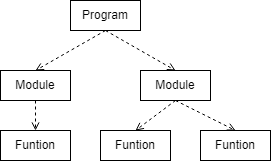
- Interfaces and abstract classes are high-level resources
- Concrete classes are low-level resources
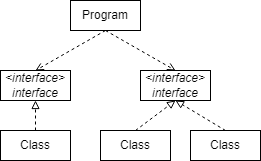
Inversion of Ownership
- Its not just an inversion of dependency, DIP also inverts ownership.
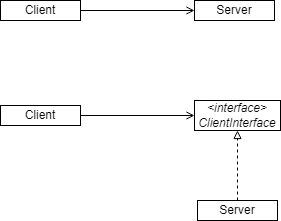
- Typically a service interface is “owned” or declared by the server, here the client is specifying what they want from the server
- DIP → Clients should own the interface.
The dependency inversion principle

- High-level modules make calls to low-level modules.
- The upper-level layer is dependent upon lower-level layers.
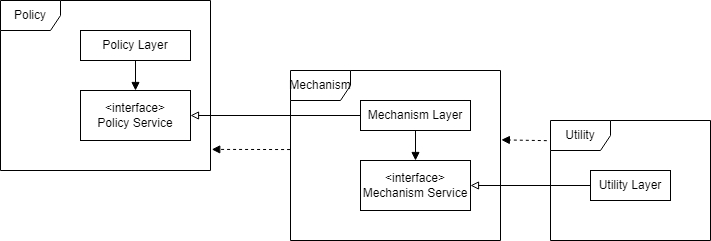
- Dependency Inversion: Lower-level layers is dependent upon upper-level layers.
- The client (upper-level layer) owns the interface, not the lower-level layers.
Interface Segregation Principle (ISP)
Clients should not be forced to depend on methods they do not use
- Make fine grained interfaces that are client specific.
Fat interface
- Bundling functions for different clients into one interface create unnecessary coupling among the clients.
- When one client causes the interface to change, all other clients are forced to recompile.
- Solution: Break the interface into cohesive groups.
- ISP solves non-cohesive interfaces.
- Clients should know only abstract base classes that have cohesive interfaces.
Example
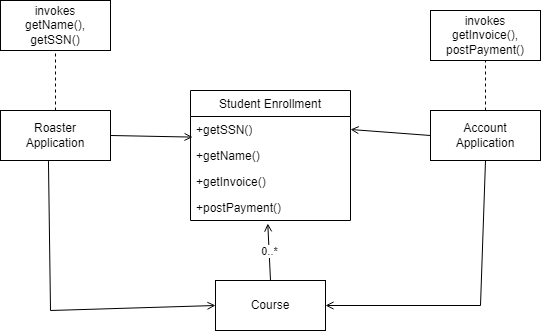
- Suppose that RoasterApplication does not invoke methods getInvoice() or postPayment().
- Also suppose AccountApplication does not invoke the methods getName() or getSSN().
- Requirements change: add a new argument to the postPayment().
- This change force us to recompile and redeploy RoasterApplication, which does not care at all about the postPayment().
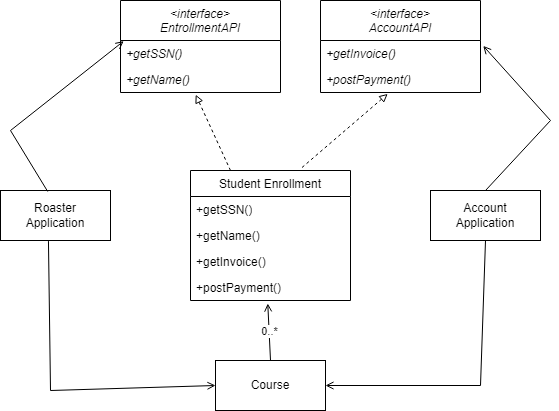
- Now, each user of a StudentEnrollment object is given an interface that provides just the methods that it is interested in.
- This protects the user from changes in methods that don’t concern it.
- It also protects the user from knowing too much about the implementation of the object it is using.