Overview
Purpose
- Defines a set of encapsulated algorithms that can be swapped to carry out a specific behavior.
Use When
- The only difference between many related classes is their behavior.
- Multiple versions or variations of an algorithm are required.
- The behavior of a class should be defined at runtime.
- Conditional statements are complex and hard to maintain.
Example
Original Design
- Requirements
- Every duck quacks.
- Every duck swims in the same way.
- Every duck requires its own display implementation.
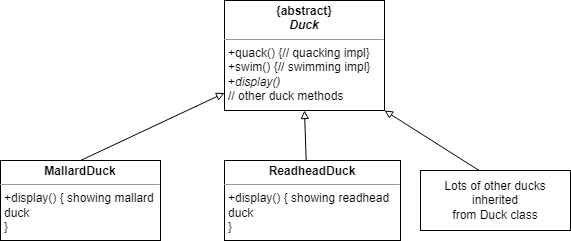 Our Original Design
Requirement Changes...
- The original desing has been okay.
- We just got additional requirement - We need to add fly behavior to ducks.
- Let's add it to the base class!
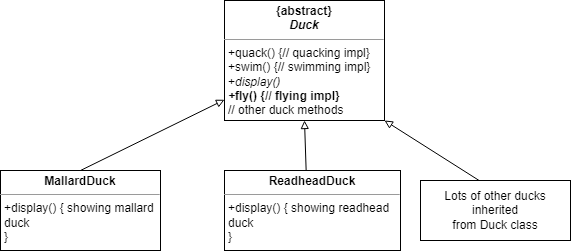 Our First Attempt
Add a Rubber Duck
- A rubber duck can't fly, at least in our application!
- Overriding RubberDuck would solve the problem.
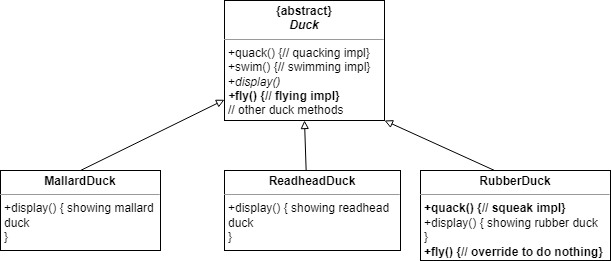 Overriding RubberDuck
More and More Ducks to Override
- Suppose we have to add a decoy duck.
- The decoy duck cannot fly and cannot quack.
- Would it be efficient to override every time?
What we have here
- A localize update to the code caused a non-local side effect.
- A great use of inheritance for the purpose of reuse hasn't turned out so well when time comes to maintenance.
Our Second Attempt: How about an Interface?
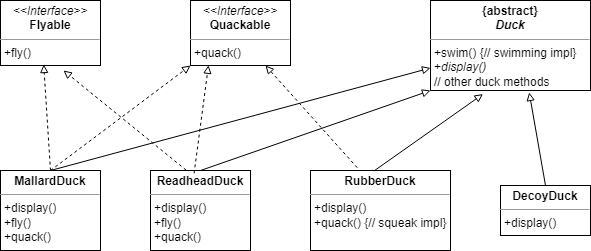 Our Second Attempt
- Completely destroy code reuse.
- Create a different maintenance nightmare.
- There might be more than one kind of flying behavior even among the ducks that do fly.
Design Principle
Encapsulate What Varies
- Identify the aspects of your application that vary and separate them from what stays the same.
Seperating What Changes From What Stays The Same
- What is changing in SimDuck?
- Flying behavior and quack behavior.
- Each type of behavior has a familiy.
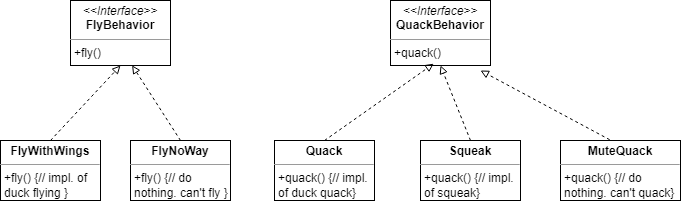
- To separate these behaviors from the Duck class, we'll
- pull both methods out the Duck class.
- create a new set of classes to represent each bahavior.
Program to and interface, not an implementation
- Programming to a super type.
- Exploit Polymorphism.
- The declared type of the variables should be a super type.
- The class declaring them doesn't have to know the actual object types.
- Programming to an implementation would be:
Dog d = new Dog();
d.bark();
- Programming to an interface/supertype would be:
Animal a = new Dog();
a.makeSound();
- Even better, rather than hard-coding the instantiation of the subtype into the code, assign the concrete implementation object at runtime:
Animal a = getAnimal("Dog");
a.makeSound();
Improved Design
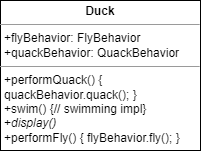
Class Duck
public abstract class Duck {
FlyBehavior flyBehavior;
QuackBehavior quackBehavior;
public Duck() {
}
public abstract void display();
public void performFly() {
flyBehavior.fly();
}
public void performQuack() {
quackBehavior.quack();
}
public void swim() {
System.out.println("All ducks float, even decoys!");
}
}
Interface FlyBehavior
public interface FlyBehavior {
    public void fly();
}

public class FlyWithWings implements FlyBehavior {
    public void fly() {
        System.out.println("I'm flying!!");
    }
}

public class FlyNoWay implements FlyBehavior {
    public void fly() {
        System.out.println("I can't fly");
    }
}
Interface QuackBehavior
public interface QuackBehavior {
    public void quack();
}

public class Quack implements QuackBehavior {
    public void quack() {
        System.out.println("Qauck");
    }
}

public class MuteQuack implements QuackBehavior {
    public void quack() {
        System.out.println("<<silence>>");
    }
}

public class Squeak implements QuackBehavior {
    public void quack() {
        System.out.println("Squeak");
    }
}
Concrete Ducks
public class MallardDuck extends Duck {
    public MallardDuck() {
        quackBehavior = new Quack();
        flyBehavior = new FlyWithWings();
    }

    public void display() {
        System.out.println("I'm a real Mallard Duck");
    }
}
Test Drive
public class MiniDuckSimulator {
    public static void main(String[] args) {
        Duck mallard = new MallardDuck();
        mallard.performQuack();
        mallard.performFly();
    }
}
Setting behavior dynamically
public abstract class Duck {
    FlyBehavior flyBehavior;
    QuackBehavior quackBehavior;

    ...

    public void setFlyBehavior(FlyBehavior fb) {
        this.flyBehavior = fb;
    }

    public void setQuackBehavior(QuackBehavior qb) {
        this.quackBehavior = qb;
    }
}
The Big Picture
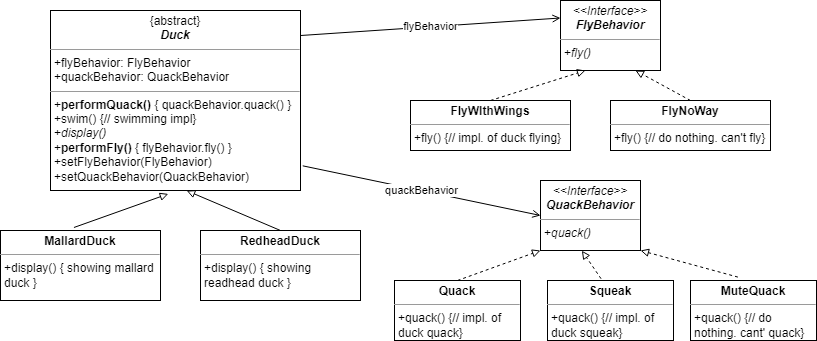
Design principle: Favor Composition Over Inheritance (or Composing Objects Principle)
- Classes should achieve polymorphic behavior and code reuse
- by their composition rather than inheritance (= by containing instances of other classes implementing the desired functionality)
- Delegation
- passing method calls to a composed object
- Favor (Object) Composition over (Class) Inheritance
- Most design patterns emphasize object composition over inheritance whenever it is possible.
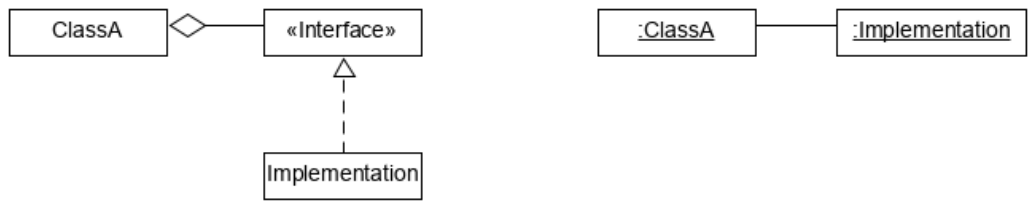
Reuse in Object-Oriented System
- Class Inheritance
- subclass' implementation is defined in terms of the parent class' implementation.
- the parent class implementation is often visible to the subclasses.
- While-box reuse
- pros
- done at compile-time and is easy to use.
- cons
- the subclass becomes dependent on the parent class implementation.
- the inherited implementation cannot be changed at run-time.
- Object Composition
- object are composed to achieve more complex functionality.
- needs well-defined interfaces since the internals of the objects are unknown.
- functionality is acquired dynamically at run-time by utilizing references to other objects.
- Black-box reuse
- pros
- implementations can be replaced at runtime.
- less implementation dependencies.
- harder to understand.
The Strategy Pattern
- Strategy Pattern
- Defines a family of algorithms,
- Encapsulates each one,
- And makes them interchangeable.
- Strategy Pattern lets the algorithm vary independently from clients that use it.
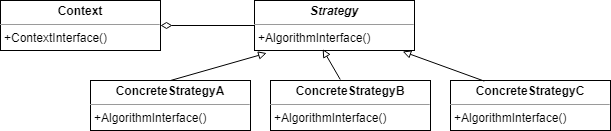 Strategy Pattern
Sorting Example
- Requirement
- we want to sort a list of integers using different sorting algorithms, e.g. quick sort, selection sort, insertion sort, etc.
- One way to solve this problem is to write a function for each sorting algorithm.
- A better way is to use the Strategy pattern.
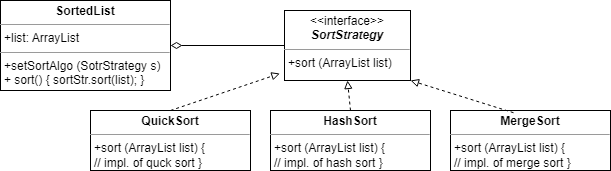 Sorting Example