Basic Concepts
- CPU scheduling is the basis of multiprogrammed operating systems.
- The objective of multiprogramming is to have some processes running at all times to maximize CPU utilization.
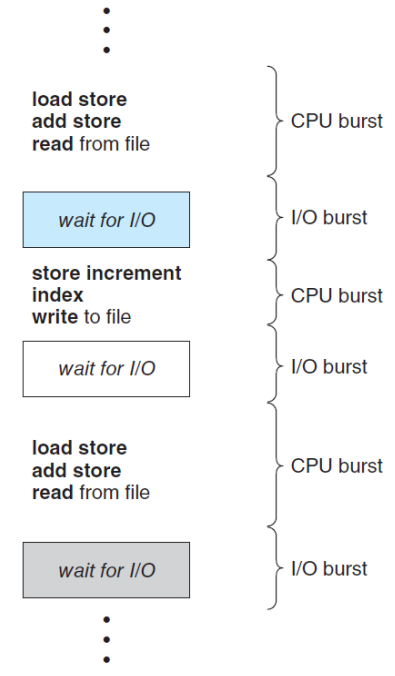
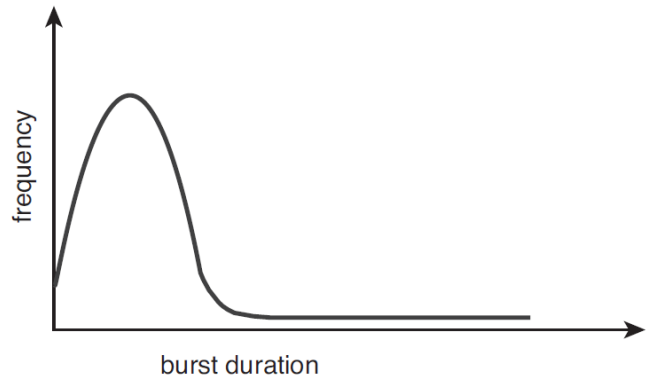
- CPU scheduler selects a process from the processes in memory that are ready to execute and allocates the CPU to that process.
- Then, how can we select a next process?
- Linked List? or Binary Tree?
- FIFO Queue
- Priority Queue: How can we determine the priority of a process?
Preemptive vs Non-preemptive
Non-preemptive scheduling
- A process keeps the CPU until it releases it, either by terminating or by switching to the waiting state.
Preemptive scheduling
- A process can be preempted by the scheduler.
Decision Making for CPU-scheduling
- When a process switches from the running to waiting state.
- When a process switches from the running to ready state.
- When a process switches from the waiting to ready state.
- When a process terminates.
No. 1 & 4: no choice – non-preemptive.
No. 2 & 3: choices – preemptive or non-preemptive.
Dispatcher
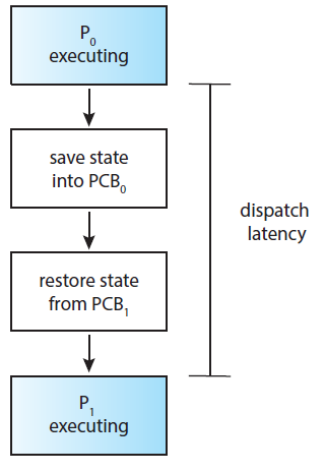
The dispatcher is a module that gives control of the CPU’s core to the process selected by the CPU scheduler.
The functions of dispatcher:
- Switching context from one process to another -> Context Switching
- Switching to user mode
- Jumping to the proper location to resume the user program
The dispatcher should be as fast as possible since it is invoked during every context switch.
The dispatcher latency is the time to stop one process and start another running.
Scheduling Criteria
- CPU utilization: To keep the CPU as busy as possible.
- Throughput: The number of processes completed per time unit.
- Turnaround time: How long does it take to execute a processfrom the time of submission to the time of completion.
- Waiting time:
- The amount of time that a process spends waiting in the ready queue.
- The sum of periods spend waiting in the ready queue.
- Response time: The time it takes to start responding.
Scheduling Algorithm
- CPU Scheduling Problem: Decide which of the processes in the ready queue is to be allocated the CPU’s core.
- The solutions for the scheduling problem
- FCFS: First-Come, First-Served
- SJF: Shortest Job First (SRTF: Shortest Remaining Time First)
- RR: Round-Robin
- Priority-based
- MLQ: Multi-Level Queue
- MLFQ: Multi-Level Feedback Queue
FCFS Scheduling
The simplest CPU-scheduling algorithm.
The process that requests the CPU first is allocated the CPU first.
- can be easily implemented with a FIFO queue.
Consider the following set of processes that arrive at time 0, with the length of the CPU burst given in milliseconds
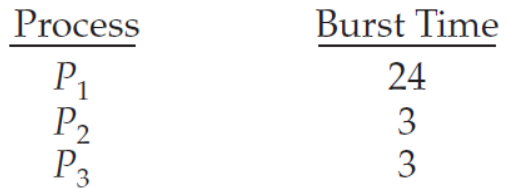
- If the processes arrive in the order 𝑃1, 𝑃2, 𝑃3:

Calculate the Waiting time of this schedule
- Waiting Time for 𝑃1 = 0, 𝑃2 = 24, 𝑃3 = 27
- Total Waiting Time: (0 + 24 + 27) = 51
- Average Waiting Time: 51/3 = 17
Let us calculate the Turnaround time:
- Turnaround Time for 𝑃1 = 24, 𝑃2 = 27, 𝑃3 = 30
- Total Turnaround Time: (24 + 27 + 30) = 81
- Average Turnaround Time: 81/3 = 27
If the processes arrive in the order 𝑃2, 𝑃3, 𝑃1:

Calculate the Waiting time of this schedule.
- Waiting Time for 𝑃1 = 6, 𝑃2 = 0, 𝑃3 = 3
- Total Waiting Time: (6 + 0 + 3) = 9
- Average Waiting Time: 9/3 = 3
Let us calculate the Turnaround time:
- Turnaround Time for 𝑃1 = 30, 𝑃2 = 3, 𝑃3 = 6
- Total Turnaround Time: (30 + 3 + 6) = 39
- Average Turnaround Time: 39/3 = 13
Note that
- The average waiting time under the FCFS policy is generally not minimal and may vary substantially if the processes’ CPU-burst times vary greatly.
- Preemptive or non-preemptive?
- The FCFS scheduling algorithm is non-preemptive.
Note also that
- The performance in a dynamic situation:
- What if we have one CPU-bound and many I/O-bound processes?
- CPU-bound가 큰 𝑃1과, 다른 𝑃들이 있을 때
- 𝑃1이 가장 먼저 도착해버리면 나머지 𝑃들은 대기 시간이 길어짐 -> waiting time이 너무 길어짐(Convoy Effect)
- Convoy Effect:
- All the other processes wait for the one big process to get off the CPU.
- Results in lower CPU and device utilization than might be possible if the shorter processes were allowed to go first.
- The performance in a dynamic situation:
SJF Scheduling
- Shortest-Job-First: shortest-next-CPU-burst-first scheduling.
- SJF associates with each process: the length of the process’s next CPU burst.
- When the CPU is available, assign it to the process that has the smallest next CPU burst.
- If two or more processes are even, break the tie with the FCFS.
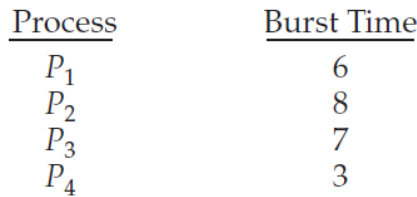

Calculate the Waiting time:
- Waiting Time for 𝑃1 = 3, 𝑃2 = 16, 𝑃3 = 9, 𝑃4 = 0
- Total Waiting Time: (3 + 16 + 9 + 0) = 28
- Average Waiting Time: 28/4 = 7
Calculate the Turnaround time:
- Turnaround Time for 𝑃1 = 9, 𝑃2 = 24, 𝑃3 = 16, 𝑃4 = 3
- Total Turnaround Time: (9 + 24 + 16 + 3) = 52
- Average Turnaround Time: 52/4 = 13
Note that
- The SJF scheduling algorithm is provably optimal, it gives the minimum average waiting time for a given set of processes.
- Moving a short process before a long one decreases the waiting time of the short process more than it increases the waiting time of the long process.
- Consequently, the average waiting time decreases.
Can you implement the SJF scheduling?
- There is no way to know the length of the next CPU burst.
- Try to approximate the SJF scheduling:
- We may be able to predict the length of the next CPU.
- Pick a process with the shortest predicted CPU burst.
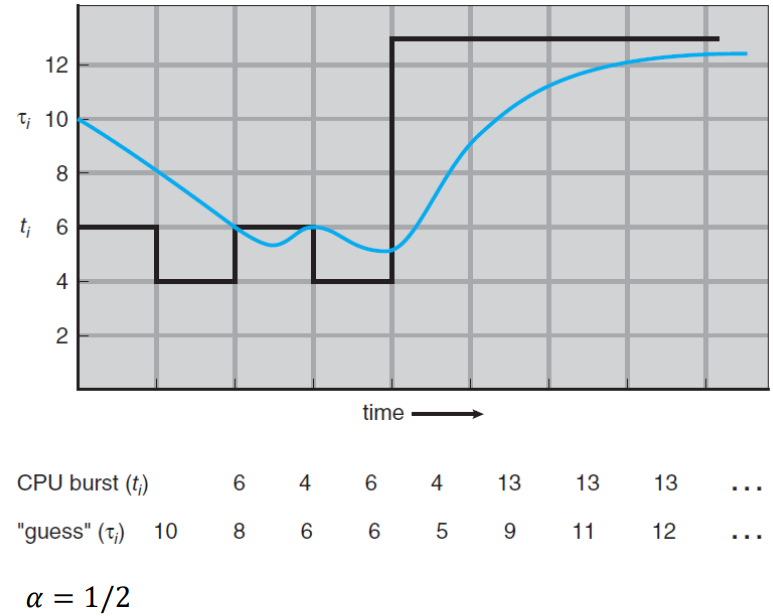
How to predict the next CPU burst?
- Exponential average of the measured lengths of previous CPU burst.
- $\tau_{n + 1} = \alpha\tau_n + (1 - \alpha)\tau_n$, where
- $\tau_n$ is the length of 𝑛th CPU burst,
- $\tau_{n+1}$ is our predicted value for the next CPU burst,
- for $ 0 <= \alpha <= 1$
- Note also that
- The SJF algorithm can be either preemptive or non-preemptive.
- The choice arises: When a new process arrives at the ready queue while a previous process is still executing.
- What if a newly arrived process is shorter than what is left of the currently executing process?
- 이론적으로는 preemptive하게 하는 것이 유리하지만, 남은 CPU burst time을 구하는 것은 쉽지 않음
SRTF Scheduling
- Shortest-Remaining-Time-First: Preemptive SJF scheduling
- SRTF will preempt the currently running process, whereas a non-preemptive SJF will allow it to finish its CPU burst.
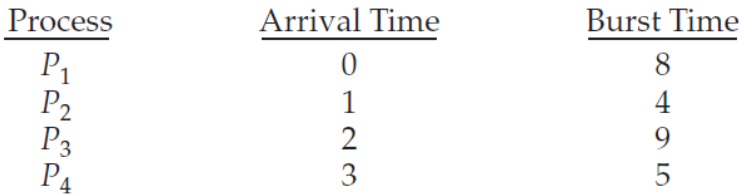

- In SRTF:
- Waiting time
- Total Waiting Time: [ 10 − 1 + 1 − 1 + 17 − 2 + 5 − 3 ] = 26
- Average Waiting Time: 26/4 = 6.5
- Turnaround Time
- Total Turnaround Time: [17 - 0 + 5 - 1 + 26 - 2 + 10 - 3] = 52
- Average Turnaround Time: 52/4 = 13
- Waiting time
- In SJF:
- Waiting time
- Total Waiting Time: [0 + 8 - 1 + 12 - 2 + 21 - 3] = 35
- Average Waiting Time: 35/4 = 8.75
- Turnaround Time
- Total Turnaround Time: [8 - 0 + 12 - 1 + 21 - 2 + 26 - 3] = 61
- Average Turnaround Time: 61/4 = 15.25
- Waiting time
RR Scheduling
Round-Robin: preemptive FCFS with a time quantum.
A time quantum (or time slice) is a small unit of time.
- generally from 10 to 100 milliseconds in length.
The ready queue is treated as a circular queue.
The scheduler goes around the ready queue, allocating the CPU to each process for a time interval of up to 1 time quantum.
One of two things will happen:
- The process may have a CPU burst of less than one time quantum.
- The process itself will release the CPU voluntarily
- The scheduler will proceed to the next process in the ready queue.
- If the CPU burst is longer than one time quantum, the timer will go off and will cause an interrupt to the OS.
- A context switch will be executed, the process will be put at the tail of the ready queue.
- The process may have a CPU burst of less than one time quantum.
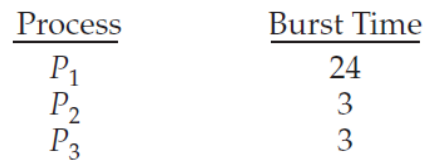

The Waiting time:
- Waiting Time for 𝑃1 = 10 − 4 = 6, 𝑃2 = 4, 𝑃3 = 7
- Total Waiting Time: (6 + 4 + 7) = 17
- Average Waiting Time: 17/3 = 5.66
Note that
- The average waiting time under the RR policy is often long.
- The RR scheduling algorithm is preemptive.
- If a process’s CPU burst exceeds one time quantum, that process is preempted and is put back in the ready queue.
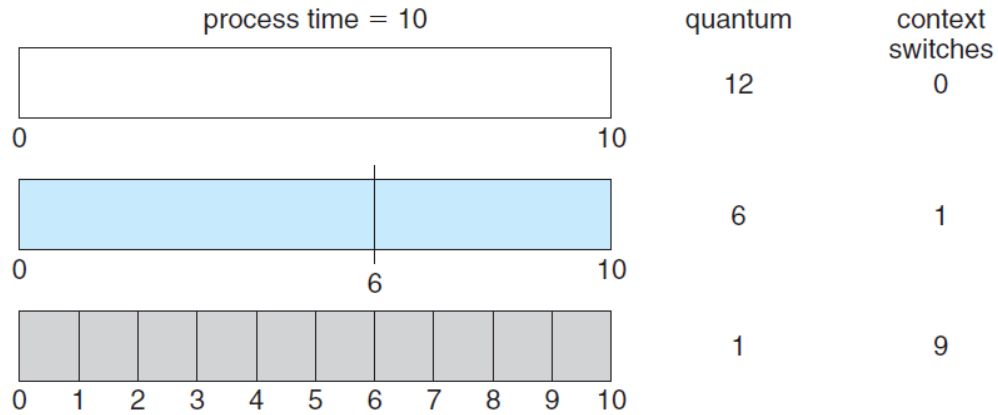
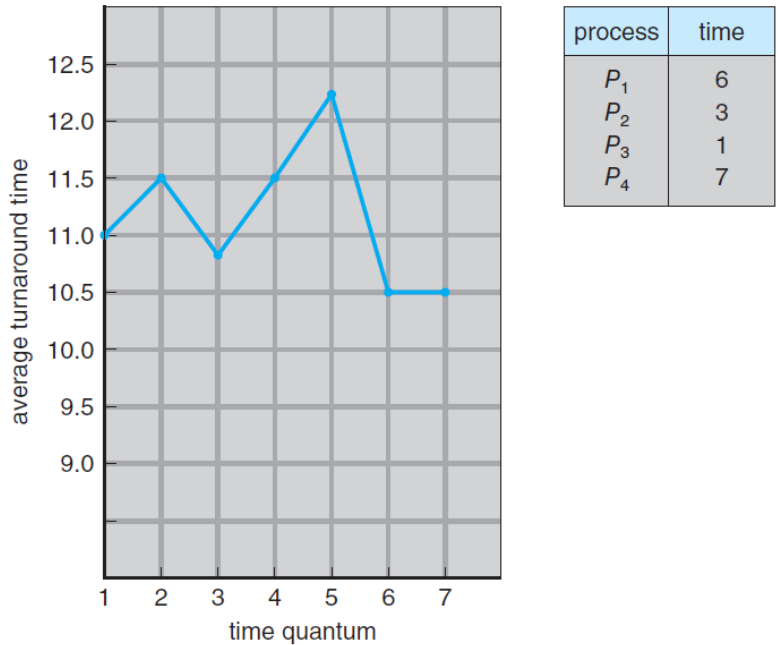
The performance of the RR scheduling algorithm depends heavily on the size of the time quantum.
Priority base Scheduling
- A priority is associated with each process, and the CPU is allocated to the process with the highest priority.
- Processes with equal priority are scheduled in FCFS order.
- Note that the SJF is a special case of the priority-based scheduling.
- In this case, the priority is the inverse of the next CPU burst.
- We assume that low numbers represent high priority.
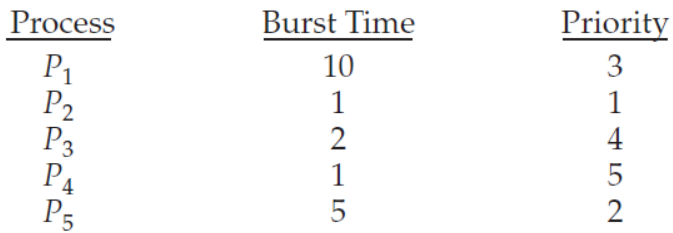

The average waiting time: 8.2
The average turnaround time: 12
Priority scheduling can be either preemptive or non-preemptive.
The problem of starvation (indefinite blocking)
- A blocked process: ready to run, but waiting for the CPU.
- Some low-priority processes may wait indefinitely.
A solution to the starvation problem is aging gradually increase the priority of processes that wait in the system for a long time.
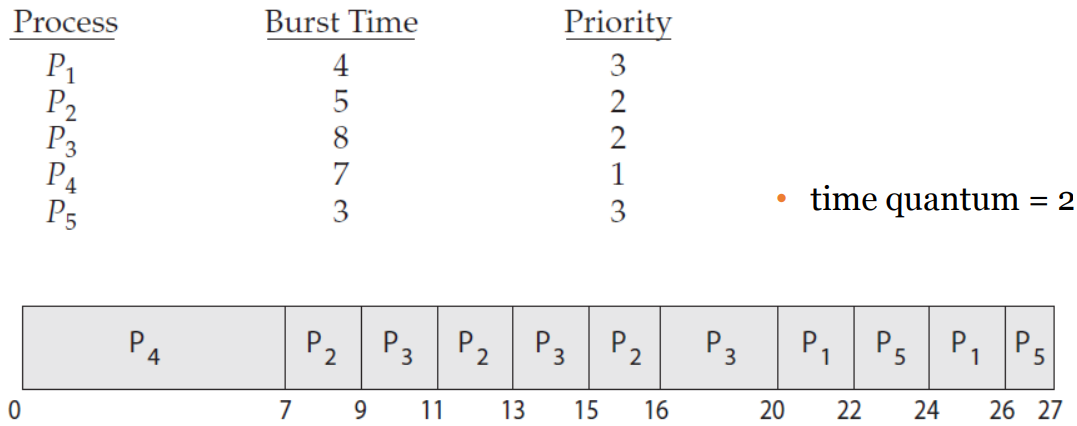
Combine RR and Priority scheduling: execute the highest-priority process and runs processes with the same priority using round-robin scheduling.
Multi-Level Queue(MLQ) Scheduling
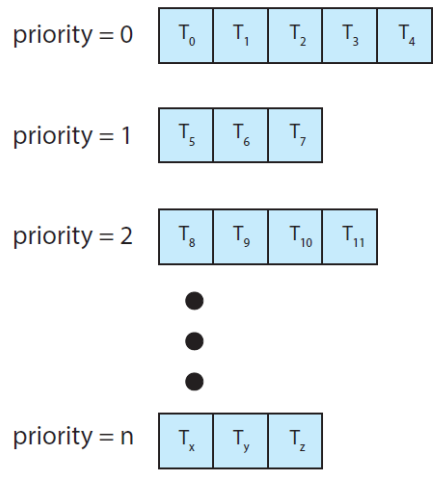
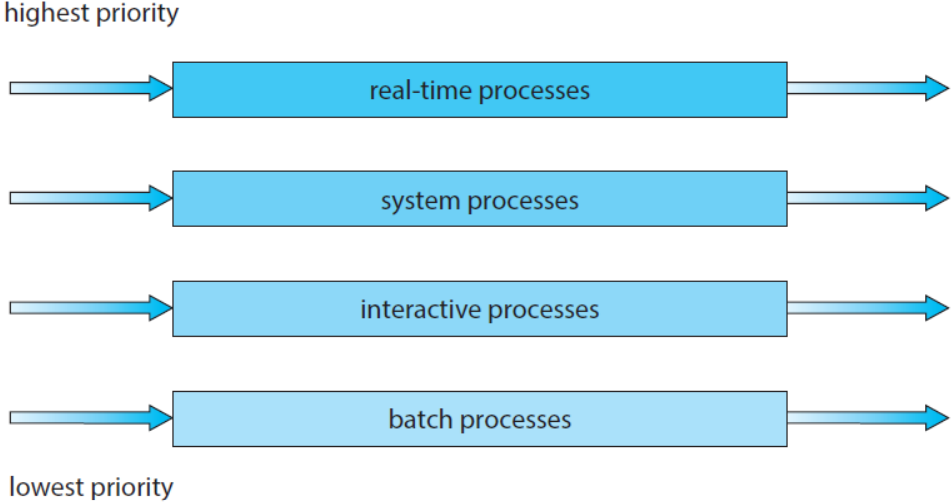
Multi-Level Feedback Queue(MLFQ) Scheduling
- MLQ같은 경우, 우선순위가 낮은 process에서 starvation이 발생할 수 있음
- 이를 방지하기 위해, Aging 기법으로 우선순위를 바꿔주는 등 다양한 방법을 도입
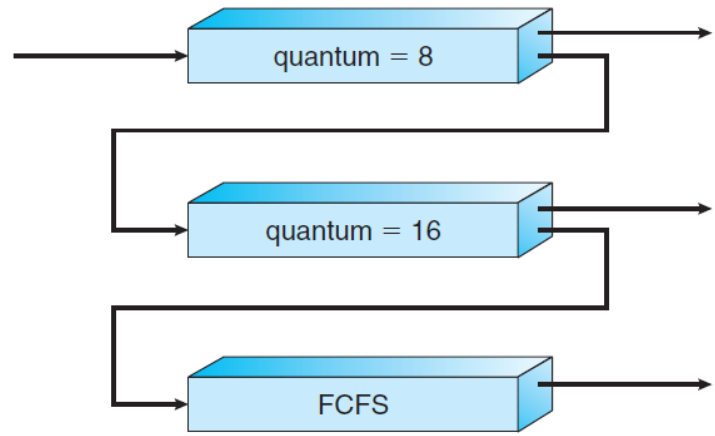
- 처음 process가 실행될 때는 quantum이 8만큼 실행
- 이때 작업이 다 끝나지 않은 상태에서 interrupt가 되면 quantum = 16인 큐로 이동하여 대기
- 이후 quantum이 16만큼 실행
- 이런 과정을 여러 큐를 두고 반복하며 점점 CPU 할당 시간을 늘려주며 실행
Thread Scheduling
- On most modern operating systems
- It is kernel threads – not processes – that are being scheduled, and user threads are managed by a thread library.
- So, the kernel is unaware of them, ultimately mapped to associated kernel threads.
Real-Time CPU Scheduling
- Soft Realtime vs Hard Realtime
- Soft real-time systems provide no guarantee
- As to when a critical real-time process will be scheduled.
- Guarantee only that a critical process is preferred to noncritical one.
- Hard real-time systems have stricter requirements.
- A task must be services by its deadline.