System Model
A deadlock is a situation in which every process in a set of processes is waiting for an event that can be caused only by another process in the set.
- A situation in which a waiting thread (or process) can never again change state, because the resources it has requested are held by other waiting threads (or processes).
Let us consider a system consisting of a finite number of resources to be distributed among a number of competing threads.
Resource types consist of some number of identical instances.
- e.g., CPU cycles, files, and I/O devices(such as printers, drives, etc.)
If a thread requests an instance of a resource type, the allocation of any instance should satisfy the request.
A thread may utilize a resource as follows: Request – Use – Release.
Deadlock in Multithreaded Applications
- How can a deadlock occur?
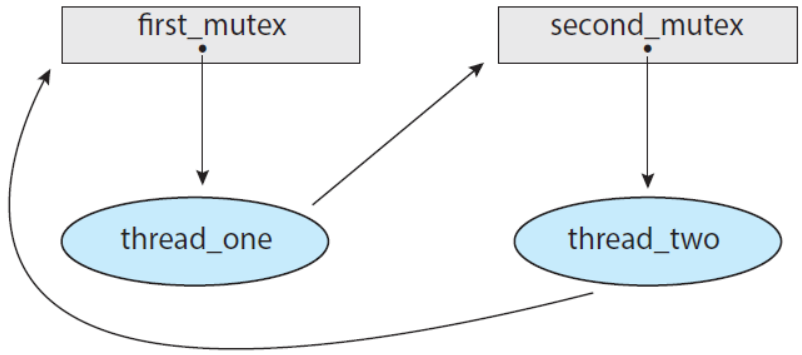
pthread_mutex_t first_mutex;
pthread_mutex_t second_mutex;

pthread_mutex_init(&first_mutex, NULL);
pthread_mutex_init(&second_mutex, NULL);

/* thread_one runs in this function */
void *do_work_one(void *param)
{
    pthread_mutex_lock(&first_mutex);
    pthread_mutex_lock(&second_mutex);
    /*
    * Do some work
    */
    pthread_mutex_unlock(&second_mutex);
    pthread_mutex_unlock(&first_mutex);

    pthread_exit(0);
}

/* thread_two runs in this function */
void *do_work_two(void *param)
{
    pthread_mutex_lock(&second_mutex);
    pthread_mutex_lock(&first_mutex);
    /*
    * Do some work
    */
    pthread_mutex_unlock(&first_mutex);
    pthread_mutex_unlock(&second_mutex);

    pthread_exit(0);
}
Deadlock Characterization
- Four Necessary Conditions:
- Mutual Exclusion: At least one resource is held in a non-sharable mode.
- Hold and Wait: A thread holds at least one resource and waiting to acquire additional resources held by other threads.
- No preemption: Resources cannot be preempted.
- Circular Wait: A set of waiting threads exist such that the dependency graph of waiting is circular.
Resource-Allocation Graph
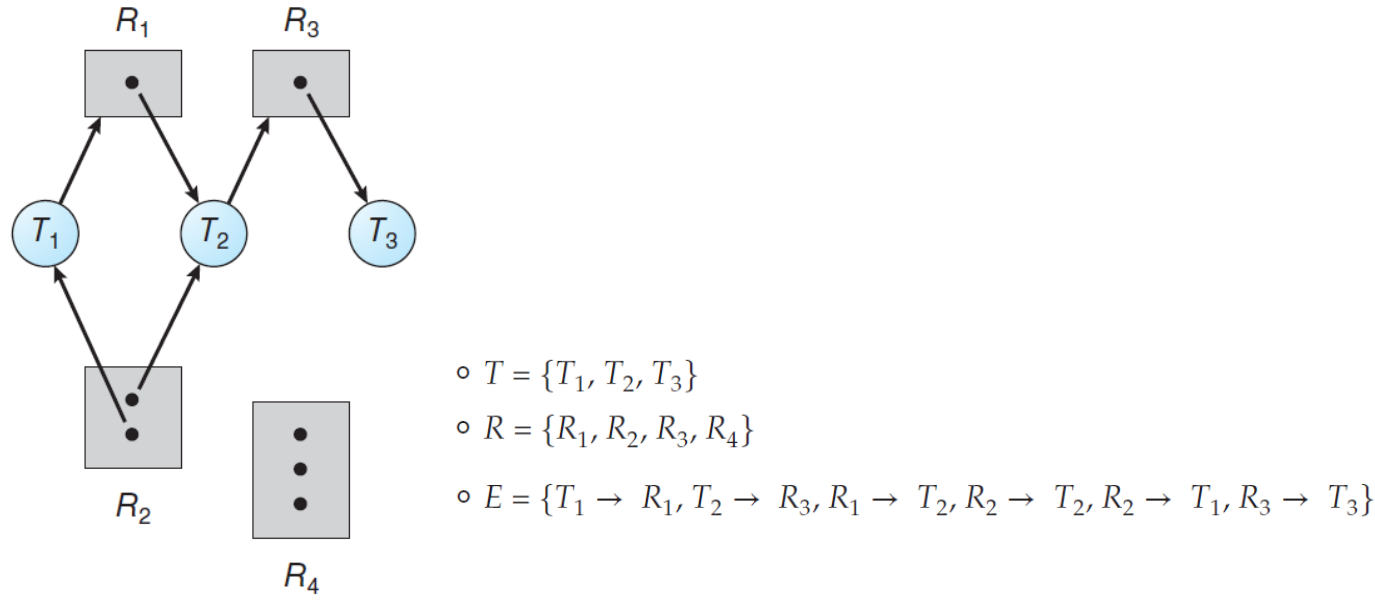
- Rsource-allocation graph is a directed graph to describe deadlocks more precisely.
- consists of a set of vertices 𝑉 and a set of edges 𝐸.
- Two different node types of V:
- 𝑇 = {𝑇1, 𝑇2, ⋯ , 𝑇𝑛}: the set of all the active threads in the system.
- 𝑅 = {𝑅1, 𝑅2, ⋯ , 𝑇𝑚}: the set of all the resource types in the system.
- A directed edge: 𝑇𝑖 → 𝑅𝑗 (request edge)
- signifies that a thread 𝑇𝑖 has requested an instance of 𝑅𝑗.
- A directed edge: 𝑅𝑗 → 𝑇𝑖 (assignment edge)
- signifies that an instance of 𝑅𝑗 has been allocated to a thread 𝑇𝑖.
- An important observation
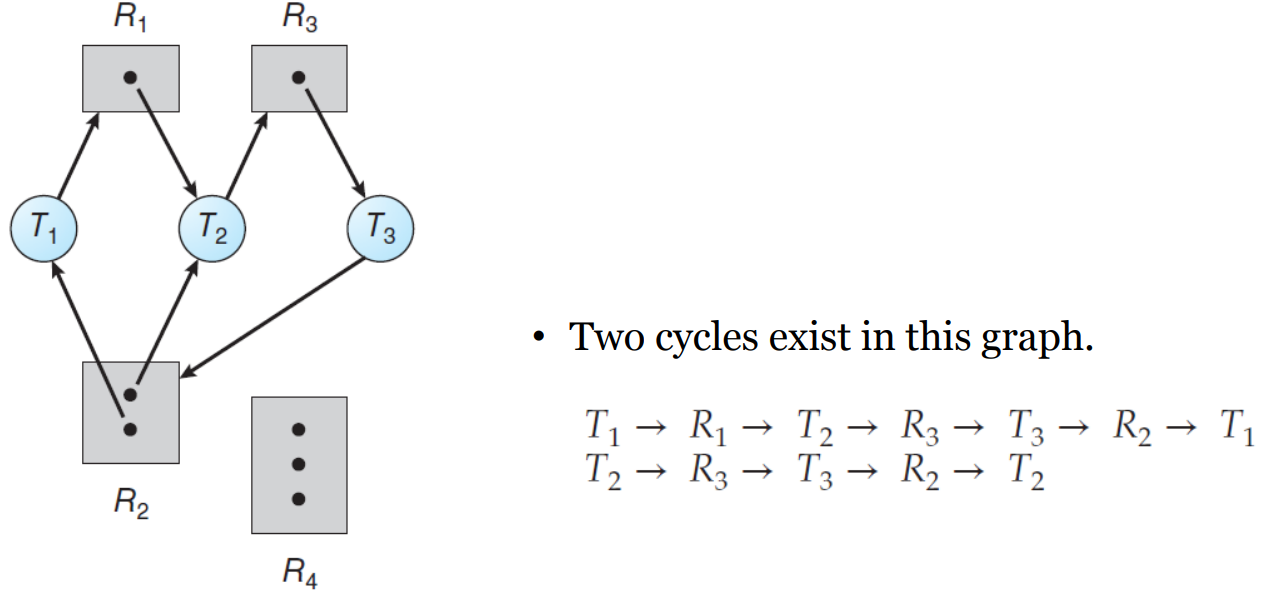
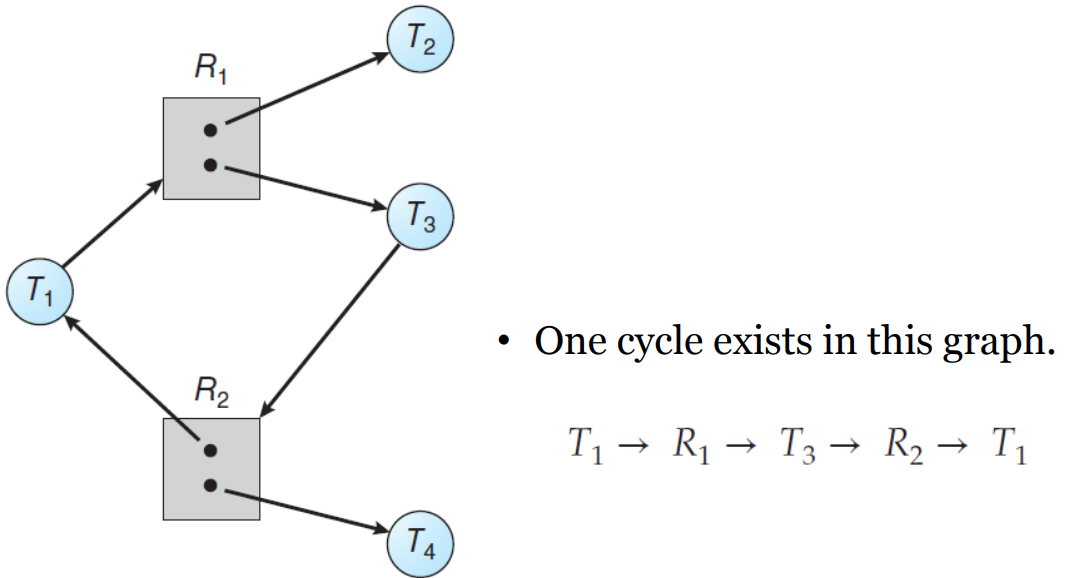
- If a resource-allocation graph does not have a cycle, then the system is not in a deadlocked state.
- If a resource-allocation graph has a cycle, then the system may or may not be in a deadlocked state.
Methods for Handling Deadlocks
- Three ways of dealing with the Deadlock Problem
- Ignore the problem altogether and pretend that deadlocks never occur in the system.
- Use a protocol to prevent or avoid deadlocks, ensuring that the system will never enter a deadlocked state.
- Deadlock Prevention: 거의 불가능
- Deadlock Avoidance: Banker’s Algorithm
- Allow the system to enter a deadlocked state, then detect it, and recover it.
- Deadlock Detection
- Recovery from Deadlock
Deadlock Prevention
For a deadlock to occur, each of the four necessary conditions must hold.
Hence, we can prevent the occurrence of a deadlock, by ensuring that at least one of these conditions cannot hold.
- Mutual Exclusion
- Hold and Wait
- No Preemption
- Circular Wait
Mutual Exclusion
- At least one resource must be non-sharable.
- In general, it cannot be applied to most applications.
- some resources are intrinsically non-sharable.
- e.g., a mutex lock cannot be shared by several threads.
Hold and Wait
- We can guarantee that, whenever a thread requests a resource, it does not hold any other resources.
- It is impractical for most applications.
No preemption
- We can use a protocol to ensure that there should be preemption.
- If a thread is holding some resources and requests another resources that cannot be immediately allocated to it.
- then, all resources the thread is currently holding are preempted.
- The preempted resources are added to the list of resources for which the threads are waiting.
- The thread will be restarted only when it can regain its old resources as well as new ones.
- Cannot generally be applied to most applications.
Circular Wait: sometimes practical.
- Impose a total ordering of all resource types and to require that each thread requests resources in an increasing order of enumeration.
- It is provable that these two protocols are used, then the circular-wait condition cannot hold.
- Note that, however, imposing a lock ordering does not guarantee deadlock prevention, if locks can be acquired dynamically.
/* Deadlock example with lock ordering */

void transaction(Account from, Account to, double amount)
{
    mutex lock1, lock2;
    lock1 = get_lock(from);
    lock2 = get_lock(to);

    acquire(lock1);
        acquire(lock2);

            withdraw(from, amount);
            deposit(to, amount);

        release(lock2);
    release(lock1);
}

transaction(checking_account, saving_account, 25.0);
transaction(saving_account, checking_account, 50.0);
- The Demerits of the Deadlock Prevention
- It prevents deadlocks by limiting how requests can made, ensuring that at least one of the necessary conditions cannot occur.
- However, possible side effects of preventing deadlocks are low device utilization and reduced system throughput.
Deadlock Avoidance
Let the system to decide for each request whether or not the thread should wait in order to avoid a possible future deadlock.
It requires additional information about how resources are to be requested.
For example, in a system with resources 𝑅1 and 𝑅2,
- A thread 𝑃 will request first 𝑅1 and then 𝑅2 before releasing them.
- A thread 𝑄 will request 𝑅2 then 𝑅1.
Given a priori information, it is possible to construct an algorithm that ensures the system will never enter a deadlocked state.
- Let the maximum number of resources of each type that it may need.
- Let the state of resource allocation be the number of available and allocated resources and the maximum demands of the threads.
Safe State
- A state is safe if the system can allocate resources to each thread (up to its maximum) in some order and still avoid a deadlock.
- A system is in a safe state if only if there exists a safe sequence.
- A sequence of threads 〈𝑇1, 𝑇2, ⋯ , 𝑇𝑛〉 is a safe sequence, if, for each thread 𝑇𝑖, the resources that 𝑇𝑖 can still request can be satisfied by the currently available resources + resources held by all 𝑇𝑗, with 𝑗 < 𝑖.
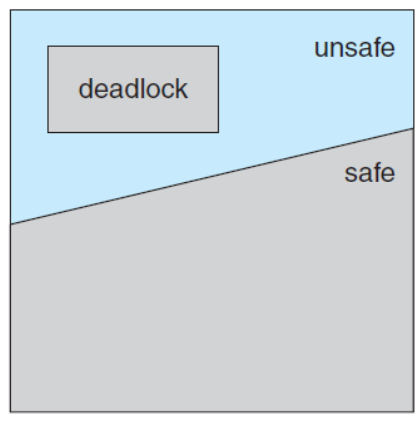
Basic facts
- A safe state is not a deadlocked state.
- Conversely, a deadlocked state is an unsafe state.
- However, not all unsafe states are deadlocks, an unsafe state may lead to a deadlock.
Given the concept of a safe state
- We can define an avoidance algorithm that ensure that the system will never enter a deadlocked state.
- The idea is simply to ensure that the system will always remain in a safe state.
- Initially, the system is in a safe state.
- Whenever a thread requests a resource that is currently available, the system decides whether the resource can be allocated or not.
- The request is granted if and only if the allocation leaves the system in a safe state.
Revisit the Resource-Allocation Graph
- Suppose that a system has only one instance of each resource type.
- Then, introduce a new type of edge, called a claim edge.
- A claim edge: 𝑇𝑖 → 𝑅𝑗 indicates that a thread may request a resource at some time in the future.
- Then we can check for the safety by a cycle-detection algorithm in a directed graph.
- If no cycle exists, the request can be granted immediately, since the resource allocation will leave the system in a safe state.
- If a cycle is detected, then the request cannot be granted, since the resource allocation will put the system in an unsafe state.
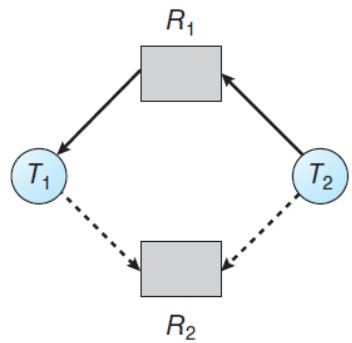
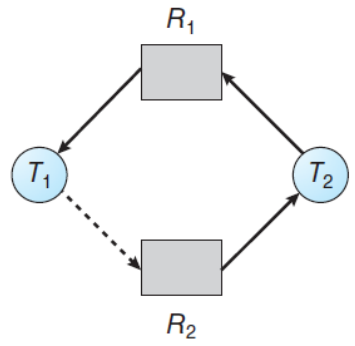
Banker's Algorithm
RAG is not applicable to a resource allocation system with multiple instances of each resource type.
Banker’s algorithm is applicable to such a system but less efficient and more complicated than the RAG.
Why Banker’s?
- The bank never allocates its available cash in such a way that it could no longer satisfy the needs of all its customers.
Data structures
- Let 𝑛 be the number of threads in the system and let 𝑚 be the number of resource types.
- Available: A vector indicates the number of available resource types.
- Max: A matrix defines the maximum demand of each thread.
- Allocation: A matrix defines the number of resources of each type currently allocated to each thread.
- Need: A matrix indicates the remaining resource need of each thread.
Data structure example
- 𝑨𝒗𝒂𝒊𝒍𝒂𝒃𝒍𝒆[𝒎]: if 𝐴𝑣𝑎𝑖𝑙𝑎𝑏𝑙𝑒[𝑗] == 𝑘, then 𝑘 instances of 𝑅𝑗 are available.
- 𝑴𝒂𝒙[𝒏 × 𝒎]: if 𝑀𝑎𝑥[𝑖][𝑗] == 𝑘, then 𝑇𝑖 may request at most 𝑘 instances of 𝑅𝑗.
- 𝑨𝒍𝒍𝒐𝒄𝒂𝒕𝒊𝒐𝒏[𝒏 × 𝒎]: if 𝐴𝑙𝑙𝑜𝑐𝑎𝑡𝑖𝑜𝑛[𝑖][𝑗] == 𝑘, then 𝑇𝑖 is currently allocated 𝑘 instances of 𝑅𝑗.
- 𝑵𝒆𝒆𝒅[𝒏 × 𝒎]: if 𝑁𝑒𝑒𝑑[𝑖][𝑗] == 𝑘, then 𝑇𝑖 may need 𝑘 more instances of 𝑅𝑗.
Safety algorithm
- Let Work and Finish be vectors of length m and n, respectively. Initialize Work = Available and Finish[i] = false for i = 0, 1, ..., n - 1.
- Find an index i such that both
- Finish[i] == false
- Needi <= Work
- If no such i exists, go to step 4.
- Work = Work + Allocationi, Finish[i] = true. Go to step 2.
- If Finish[i] == true for all i, then the system is in a safe state.
Resource-request algorithm
- If Requesti <= Needi, go to step2. Otherwise, raise an error condition, since the thread has exceeded its maximum claim.
- If Requesti <= Available, go to step 3. Otherwise, Ti must wait, since the resources are not available.
- Have the system pretend to have allocated the requested resources to thread Ti by modifying the state as follows
- Available = Available - Requesti
- Allocationi = Allocationi + Requesti
- Needi = Needi - Requesti
An Illustrative Example
- A set of five threads: 𝑇 = {𝑇0, 𝑇1, 𝑇2, 𝑇3, 𝑇4}
- A set of three resource types: 𝑅 = {𝐴, 𝐵, 𝐶}
- The number of instances of each resource types: 𝐴 = 10,𝐵 = 5, 𝐶 = 7
- The snapshot representing the current state of the system:
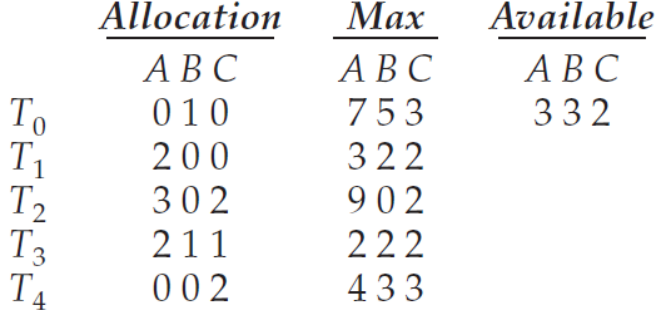
- Note that 𝑁𝑒𝑒𝑑[𝑖][𝑗] = 𝑀𝑎𝑥[𝑖][𝑗] − 𝐴𝑙𝑙𝑜𝑐𝑎𝑡𝑖𝑜𝑛[𝑖][𝑗].
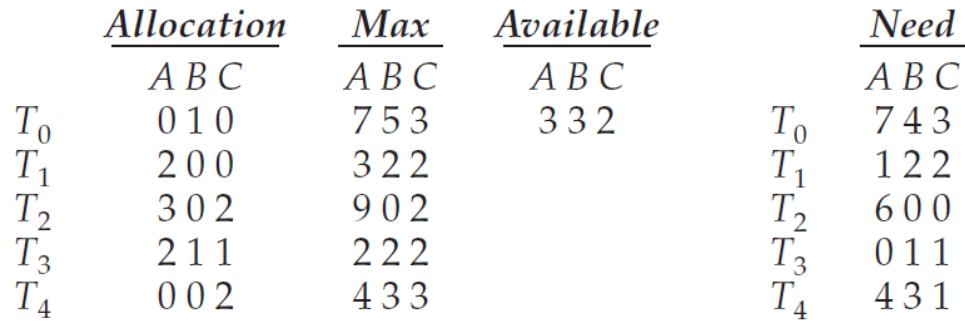
- Now we claim that the system is currently in a safe state.
- In deed, the sequence 〈𝑇1, 𝑇3, 𝑇4, 𝑇2, 𝑇0〉 satisfies the safety criteria.
/* Sequence of Safety Algorithm */

Work = {3, 3, 2}
Finish = {false, false, false, false, false} // T1 ~ T0

i = 0,
Need[0] = {7, 4, 3}
Need[0] <= Work is false

i = 1,
Need[1] = {1, 2, 2}
Need[1] <= Work is true
update Work = Work + Allocation[1] = {5, 3, 2}
update Finish = {false, true, false, false, false}

i = 2,
Need[2] = {6, 0, 0}
Need[2] <= Work is false

i = 3,
Need[3] = {0, 1, 1}
Need[3] <= Work is true
update Work = Work + Allocation[3] = {7, 4, 3}
update Finish = {false, true, false, true, false}

i = 4,
Need[4] = {4, 3, 1}
Need[4] <= Work is true
update Work = Work + Allocation[4] = {7, 4, 5}
update Finish = {false, true, false, true, true}

i = 0,
Need[0] = {7, 4, 3}
Need[0] <= Work is true
update Work = Work + Allocation[0] = {7, 5, 5}
update Finish = {true, true, false, true, true}

i = 2,
Need[2] = {6, 0, 0}
Need[2] <= Work is true
update Work = Work + Allocation[2] = {10, 5, 7}
update Finish = {true, true, true, true, true}

all elements in Finish vector are true
- When a new request is submitted
- Suppose that 𝑇1 requests one instance of 𝐴 and two instances of 𝐶.
- 𝑅𝑒𝑞𝑢𝑒𝑠𝑡1 = (1, 0, 2),
- Decide whether this request should be granted or not. - Resource-request algorithm
- 𝑅𝑒𝑞𝑢𝑒𝑠𝑡1 ≤ 𝐴𝑣𝑎𝑖𝑙𝑎𝑏𝑙e - (1,0,2) ≤ (3,3,2)
- (2,0,0) + (1,0,2) = (3,0,2)
- (3,3,2) − (1,0,2) = (2,3,0)
- (1,2,2) − (1,0,2) = (0,2,0)
- Suppose that 𝑇1 requests one instance of 𝐴 and two instances of 𝐶.
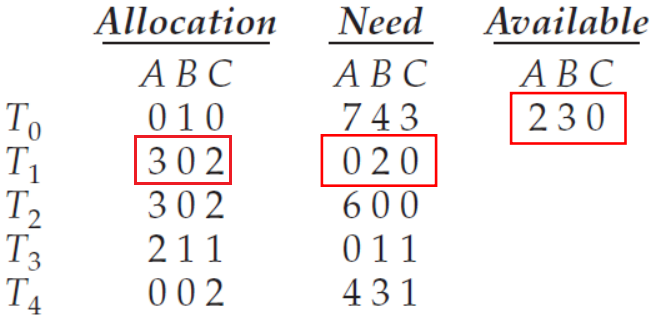
Now, determine whether this new system state is safe.
- Safety algorithm finds that 〈𝑇1, 𝑇3, 𝑇4, 𝑇0, 𝑇2〉 satisfies the safety.
Now, determine with a request of (3, 3, 0) by 𝑇4.
- 𝑅𝑒𝑞𝑢𝑒𝑠𝑡4 = (3, 3, 0)
- Request4 <= Need4: (3,3,0) <= (4,3,1)
- Request4 <= Available: (3,3,3) <= (2,3,0)
- Not true - Reject request
How about a request of (0, 2, 0) by 𝑇0?
- 𝑅𝑒𝑞𝑢𝑒𝑠𝑡0 = (0, 2, 0)
- Request0 <= Need0: (0,2,0) <= (7,4,3)
- Request0 <= Available: (0,2,0) <= (2,3,0)
- (0,1,0) + (0,2,0) = (0,3,0)
- (7,4,3) − (0,2,0) = (7,2,3)
- (2,3,0) − (0,2,0) = (2,1,0)
- Determine whether this new system state is safe.
- Safety algorithm finds that 〈𝑇1, 𝑇3, 𝑇4, 𝑇0, 𝑇2〉 does not satisfie the safety.
Deadlock Detection
If a system does not prevent or avoid the deadlock, then a deadlock situation may occur.
In this environment, the system may provide:
- An algorithm that examines the state of the system to determine whether a deadlock has occurred.
- An algorithm to recover from the deadlock.
Single Instance of Each Resource Type
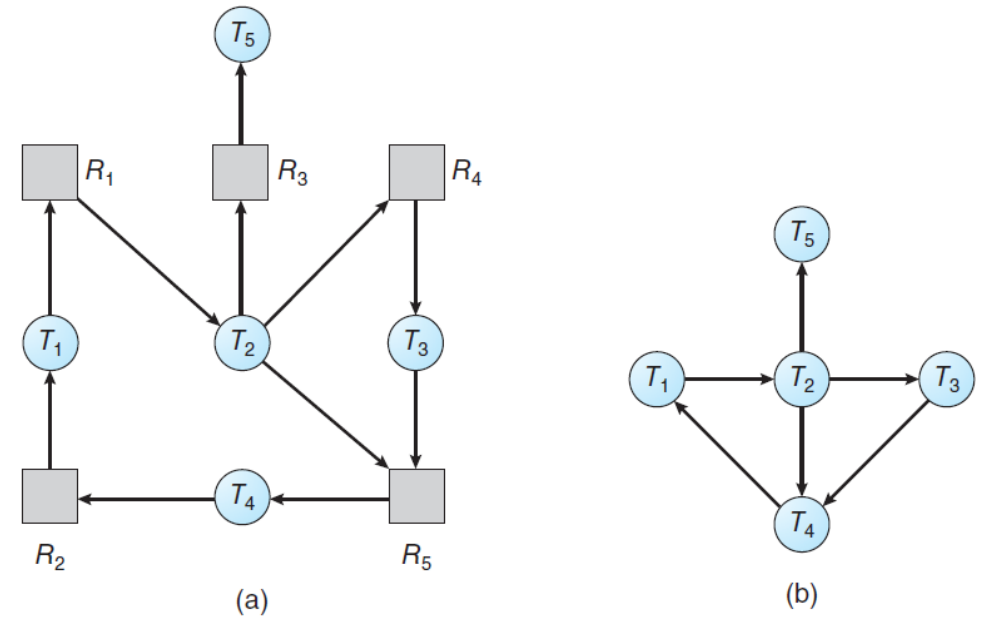
- Maintain a wait-for graph, a variant of the resource-allocation graph.
- Periodically, invoke an algorithm that searches for a cycle in the wait-for graph.
- Several Instances of a Resource Type
- The wait-for graph is not applicable to a system with multiple instances of each resource type.
- We can design a deadlock detection algorithm that is similar to those used in the banker’s algorithm.
Detection Algorithm
Data Structures
- 𝑨𝒗𝒂𝒊𝒍𝒂𝒃𝒍𝒆[𝒎]:
- 𝑨𝒍𝒍𝒐𝒄𝒂𝒕𝒊𝒐𝒏[𝒏 × 𝒎]:
- 𝑹𝒆𝒒𝒖𝒆𝒔𝒕[𝒏 × 𝒎]: indicates the current request of each thread.
- if 𝑅𝑒𝑞𝑢𝑒𝑠𝑡[𝑖][𝑗] == 𝑘, then 𝑇𝑖 is requesting 𝑘 more instances of 𝑅𝑗.
Detection algorithm
- Let Work and Finish be vectors of length m and n, respectively. Initialize Work = Available. For i = 0, 1, ..., n - 1, if Allocationi != 0, then Finish[i] = false. Ohterwise, Finish[i] = true.
- Find an index i such that both
- Finish[i] == false
- Requesti <= Work
- If no such i exists, go to step 4.
- Work = Work + Allocationi, Finish[i] = true. Go to step 2.
- If Finish[i] == false for some i, 0 <= i <= n, then the system is in a deadlocked state. Moreover, if Finish[i] == false, then thread Ti is deadlocked.
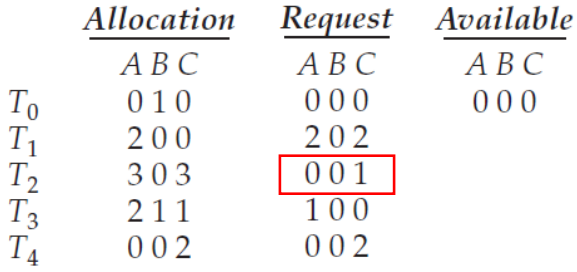
An Illustrative Example
- A set of five threads: 𝑇 = {𝑇0, 𝑇1, 𝑇2, 𝑇3, 𝑇4}
- A set of three resource types: 𝑅 = {𝐴, 𝐵, 𝐶}
- The number of instances of each resource types: 𝐴 = 7, 𝐵 = 2, 𝐶 = 6.
- The snapshot representing the current state of the system:
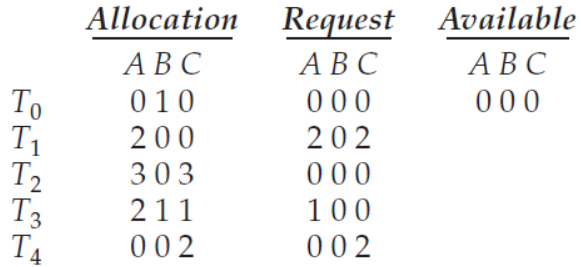
- Now we claim that the system is not in a deadlocked state.
- the sequence 〈𝑇0, 𝑇2, 𝑇3, 𝑇1, 𝑇4〉 results in 𝐹𝑖𝑛𝑖𝑠ℎ[𝑖] == 𝑡𝑟𝑢𝑒 for all 𝑖.
- Now we claim that the system is now deadlocked.
- a deadlock exists, consisting of threads 𝑇1, 𝑇2, 𝑇3, and 𝑇4.
Recovery from Deadlock
When should we invoke the detection algorithm?
- How often is a deadlock likely to occur?
- more frequent deadlocks, more frequent deadlock detections.
- How many threads will be affected by deadlock when it happens?
- the number of threads involved in the deadlock cycle may grow.
- Invoking for every request vs invoking at defined intervals.
- Note that there is a considerable overhead in computation time.
- However, there may be many cycles in the resource graph, if the detection algorithm is invoked at arbitrary points in time.
- How often is a deadlock likely to occur?
When a detection algorithm determines a deadlock exists, inform the operator that a deadlock has occurred.
- Or let the system recover from the deadlock automatically.
- Process and Thread Termination
- Resource Preemption
- Or let the system recover from the deadlock automatically.
Deadlock Recovery
- Process and Thread Termination
- Abort all deadlocked processes.
- Abort one process at a time until the deadlock cycle is eliminated.
- Resource Preemption
- Selecting a victim: consider the order of preemption to minimize cost.
- Rollback: roll back the process to some safe state and restart it.
- Starvation: picked as a victim only a finite number of times.
- Process and Thread Termination