Background
A process is a program in execution, to say, a set of instructions kept in a main memory.
A memory consists of a large array of bytes, each with its own address.
- CPU fetches instructions from memory using the program counter, and instructions may cause load from and store to the memory.
Memory Space
- We need to make sure that each process has a separate memory space.
- A pair of registers: base register and limit register provides the ability to determine the range of legal addresses.
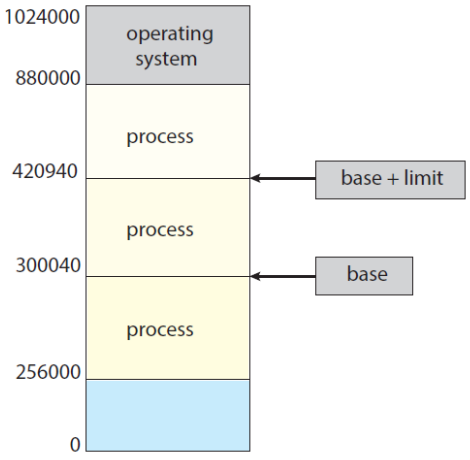
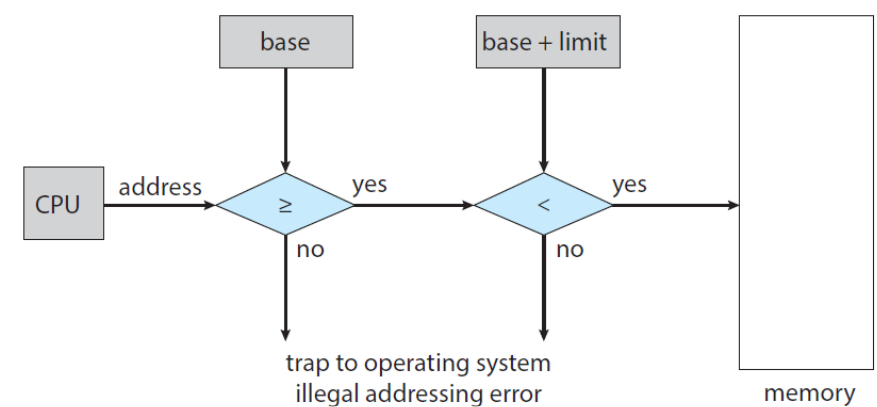
- Protection of memory space is accomplished by having the CPU hardware compare every address generated in user mode with the registers.
Address Binding
* A program resides on a disk as a binary executable file.
    * To run, the program must be brought into memory.
    * The address of the process does not start ad address 00000000.
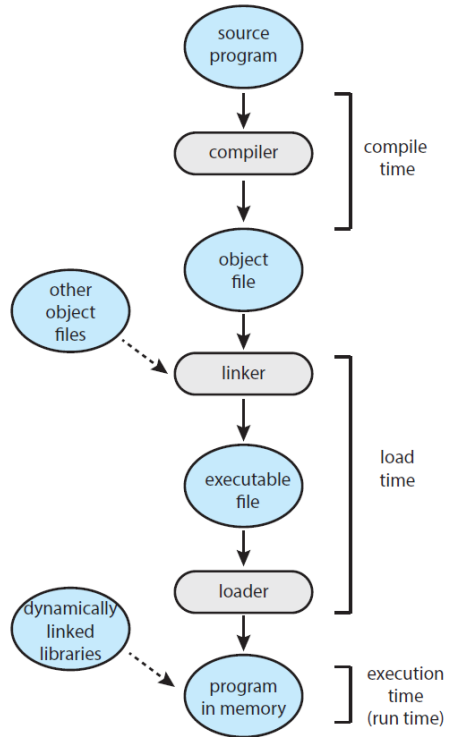
* Addresses in the source are generally symbolic.
* A compiler typically *binds symbolic* addresses to *relocatable* addresses.
* A linker or loader in turn binds the *relocatable* addresses to *absolute* addresses.
Logical vs Physical Address Space
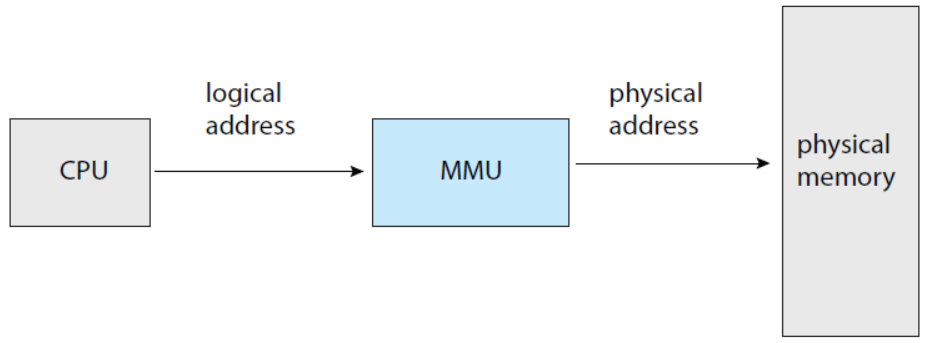
- Logical address: an address generated by the CPU.
- Physical address: an address seen by the memory unit
- that is, the one loaded into the memory-address register.
- Logical address space: the set of all logical addresses generated by a user program.
- Physical address space: the set of all physical addresses corresponding to these logical addresses.
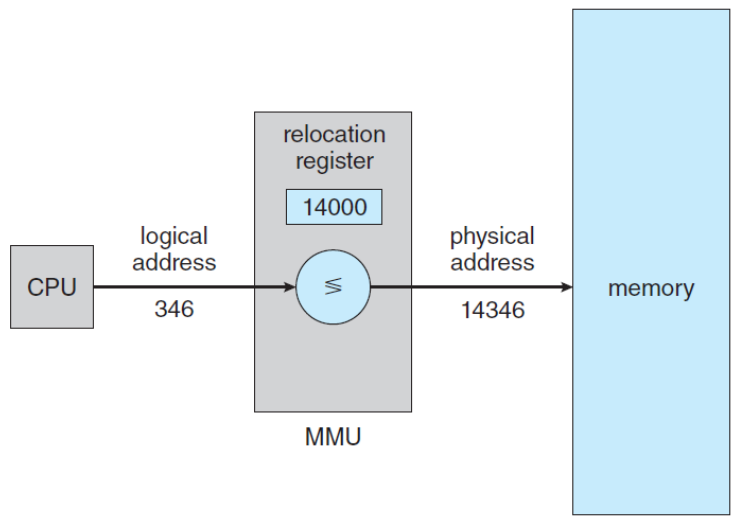
- MMU (Memory Management Unit): a hardware device that maps from logical address to physical address.
- relocation register: a base register in MMU.
Dynamic Loading
- Is it necessary for the entire program and data to be in physical memory?
- dynamic loading: obtains better memory-space utilization.
- a routine is not loaded until it is called.
- The advantage of dynamic loading is that a routine is loaded only when it is needed.
- The relocatable linking loader is called to load the desired routine and to update the program’s address tables to reflect this change.
Dynamic Linking and Shared Libraries
- DLLs: Dynamically Linked Libraries
- system libraries linked to user programs when the programs are run.
- Static linking: system libraries are treated like any other object module and are combined by the loader into the binary program code.
- Dynamic linking: is similar to dynamic loading, here, thought, linking is postponed until execution time.
- Shared library: DLLs are also known as shared libraries, since only one instance of the DLL in main memory can be shared among multiple user processes.
Contiguous Memory Allocation
- We need to allocate main memory in the most efficient way possible.
- The memory is usually divided into two partitions:
- one for the operating systems
- one for the user processes.
- Several user processes reside in memory at the same.
- How to allocate available memory to the processes that are waiting to be brought into memory?
- Contiguous memory allocation
- Each process is contained in a single section of memory that is contiguous to the section containing the next process.
Memory Protection
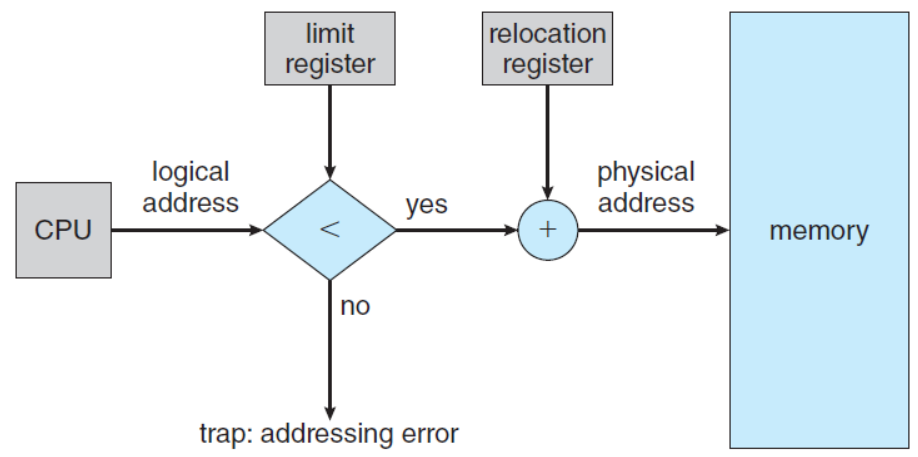
- Prevent a process from accessing memory that it does not own.
- by combining two ideas: relocation register + limit register.
Memory Allocation
- Variable-Partition scheme: one of the simplest methods.
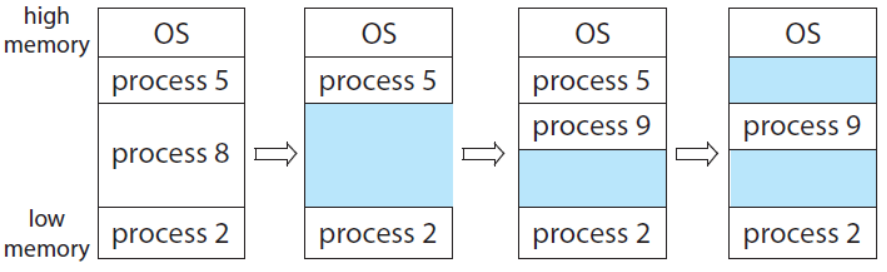
- Assign processes to variably sized partitions in memory, where each partition may contain exactly one process.
- Hole: a block of available memory.
- The Problem of Dynamic Storage Allocation
- How to satisfy a request of size 𝑛 from a list of free holes?
- Tree types of solutions to this problem:
- First-Fit: allocates the first hold that is big enough.
- Best-Fit: allocates the smallest hole that is big enough.
- Worst-Fit: allocates the largest hole.
Fragmentation
- External fragmentation
- The memory is fragmented into a large number of small holes.
- There may be enough total memory space to satisfy a request but, the available spaces are not contiguous.
- Internal fragmentation
- The memory allocated to a process may be slightly larger than the requested memory.
- Unused memory that is internal to a partition.
Paging
Paging is a memory management scheme that permits a process’s physical address space to be non-contiguous.
- Overcomes two problems of contiguous memory allocation.
- Avoid external fragmentation.
- Avoid the associated need for compaction.
- Implemented through cooperation between the operating system and the computer hardware.
- Overcomes two problems of contiguous memory allocation.
Basic Method for Paging
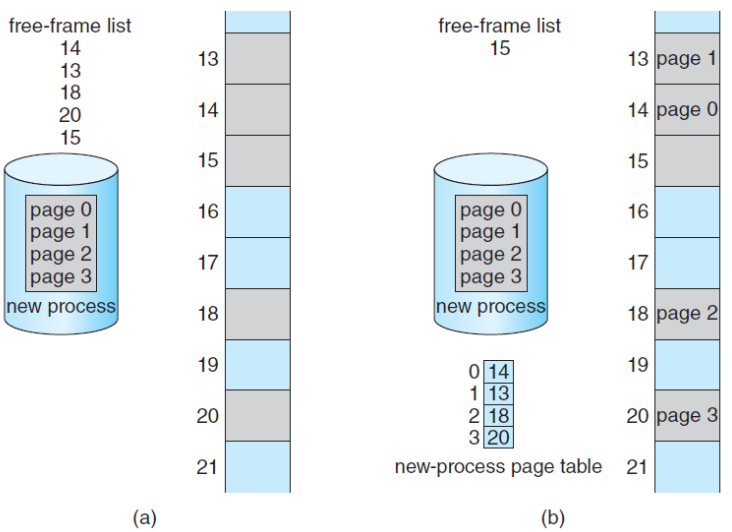
- Break physical memory into fixed-sized blocks (frames) and break logical memory into blocks of the same size (pages).
- Now, the logical address space is totally separate from the physical address space.
- Every address generated by the CPU is divided into two parts:
- a page number (p)
- a page offset (d)

- The page number is used as an index into a per-process page table.
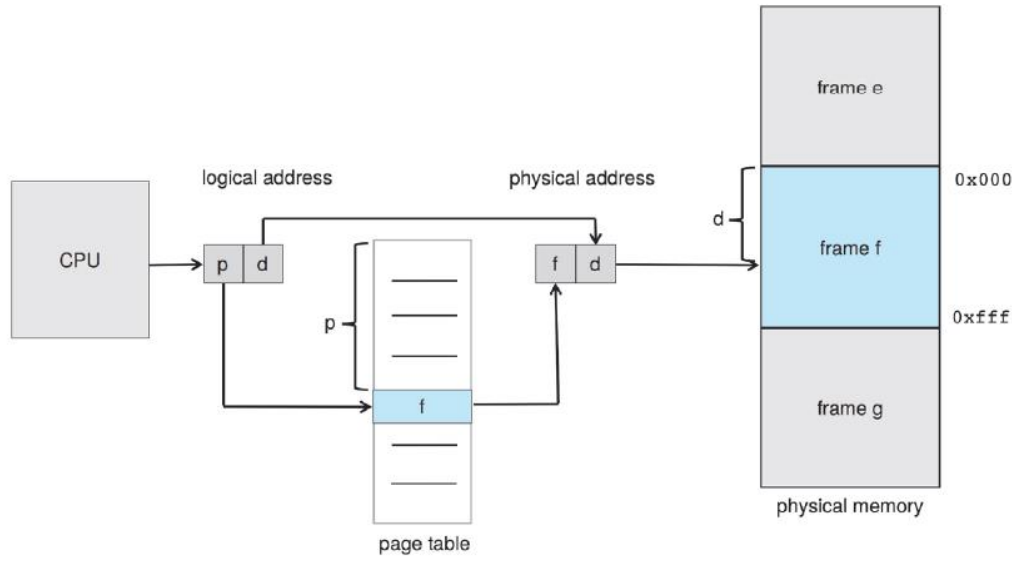
- Outlines of the steps taken by the CPU to translate a logical address to a physical address.
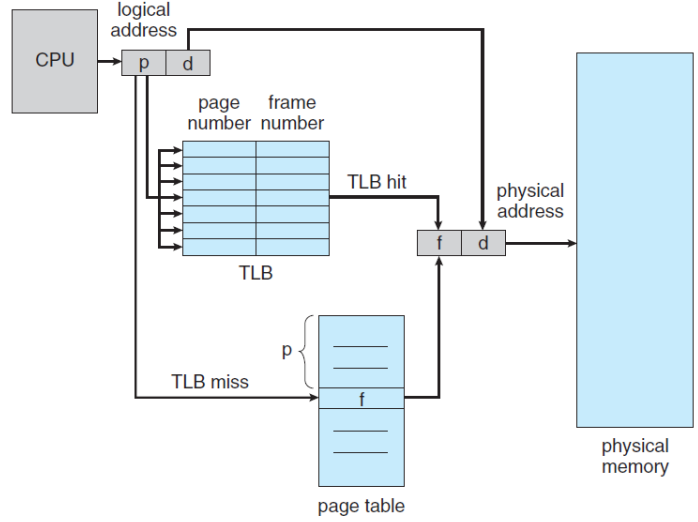
- Extract the page number 𝑝 and use it as an index into the page table.
- Extract the corresponding frame number 𝑓 from the page table.
- Replace the page number 𝑝 with the frame number 𝑓.
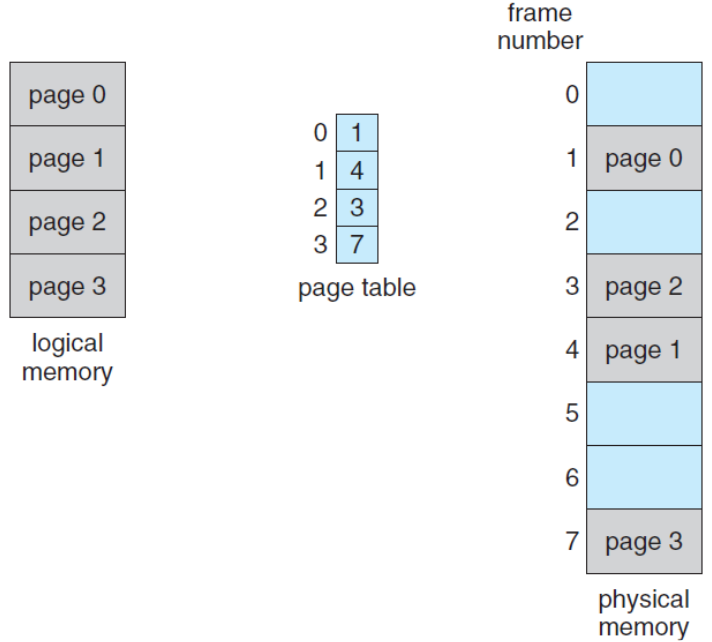
- The page size (like the frame size) is defined by the hardware.
- A power of 2: typically varying bet5ween 4KB and 1GB per page.
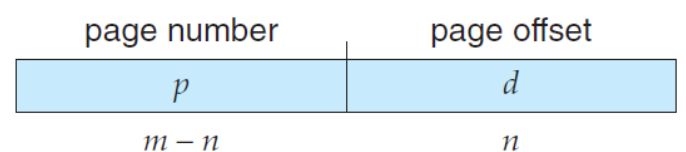
- If the size of logical address space is $2^𝑚$, and a page size is $2^𝑛$, then the high-order 𝑚 − 𝑛 bits designate the page number, and the low-order 𝑛 bits designate the page offset.
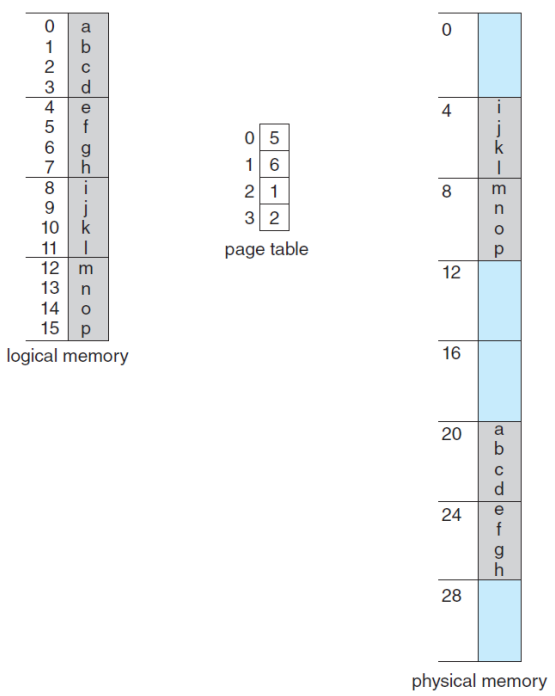
- When a process arrives in the system to be executed, its size expressed in pages is examined for memory allocation.
- Hardware Support
- When the CPU scheduler selects a process for execution, the page table should be reloaded for the context switch.
- A pointer to the page table should be stored with the other register values in the PCB of each process.
PTBR (page-table base register)
- PTBR points to the page table and the page table is kept in main memory.
- Faster context switches, but still slower memory access time.
- Two memory access is needed, one for the page-table entry, one for the actual data.
Translation Look-aside Buffer (TLB)
- TLB is a special, small, fast-lookup hardware cache memory.
- Effective Memory-Access Time
- TLB hit: if the page number of interest is in the TLB.
- TLB miss: if the page number of interest is not in the TLB.
- Hit ratio: the percentage of times that the page number of interest is found in the TLB.
- For example, in a system with 10 ns to access memory,
- 80% hit ratio: EAT = 0.80 × 10 + 0.20 × 20 = 12 𝑛𝑠.
- 99% hit ratio: EAT = 0.99 × 10 + 0.01 × 20 = 10.1 𝑛𝑠.
Memory Protection with Paging
- Memory Protection with Paging is accomplished by protection bits associated with each frame.
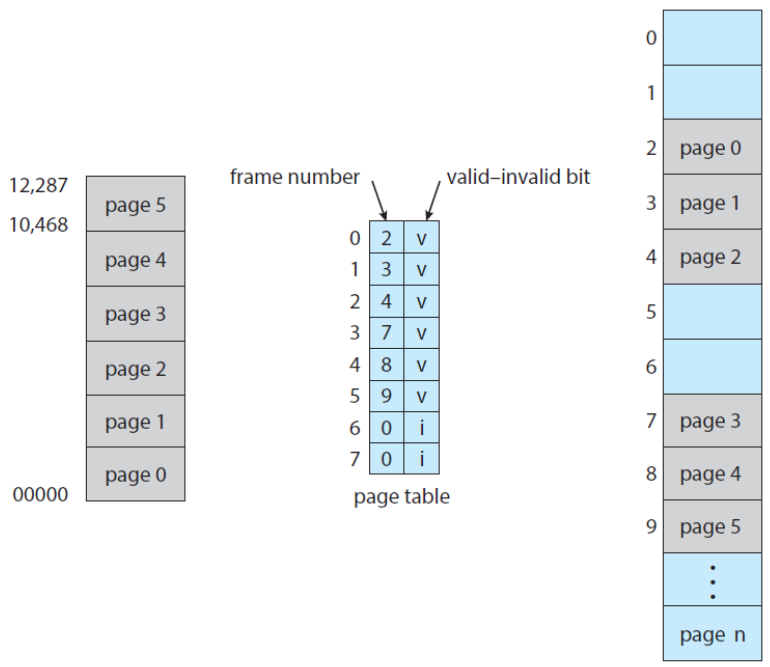
- valid-invalid bit: one additional bit generally attached to each entry in the page table.
- When this bit is set to valid: the associated page is in the process’s logical address space. (legal)
- When this bit is set to invalid: the page is not in the process’s logical address space. (illegal)
- Illegal addresses are trapped by use of the valid-invalid bit.
Shared Pages
- An advantage of paging is the possibility of sharing common code, a consideration important in a multiprogramming environment.
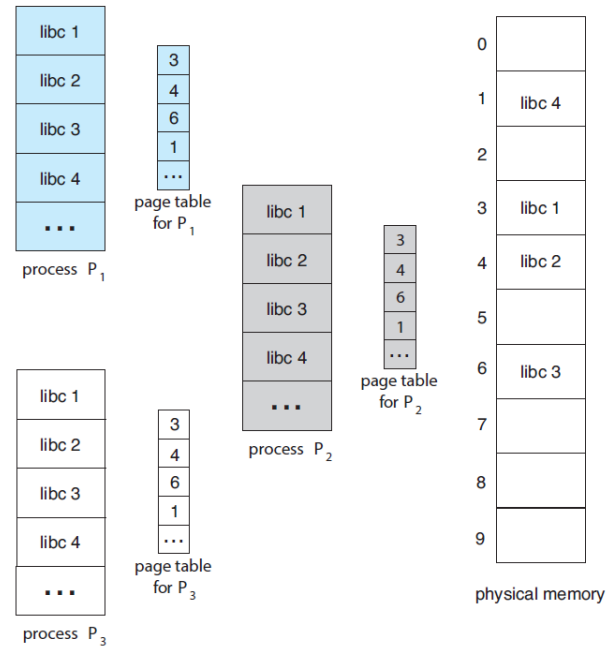
- Consider the standard C library libc.
- each process load its own copy of libc into its address space.
- however, it can be shared if the code is reentrant code.
- Reentrant code is non-self-modifying code, that is, it never changes during execution.
Structure of the Page Table
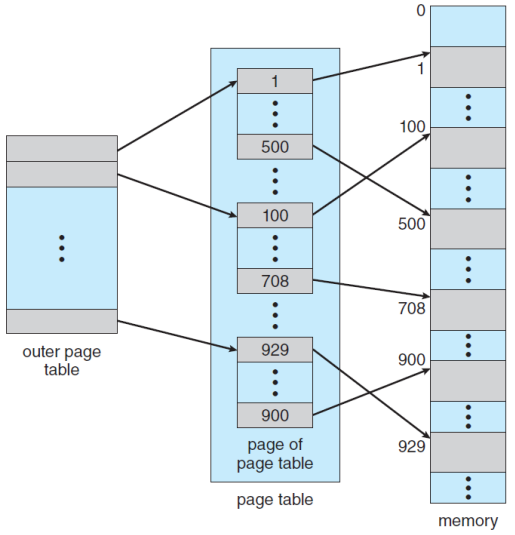
- Structuring the Page Table: A large logical address space makes the page table itself to become excessively large.
- It needs some techniques for structuring the page table.
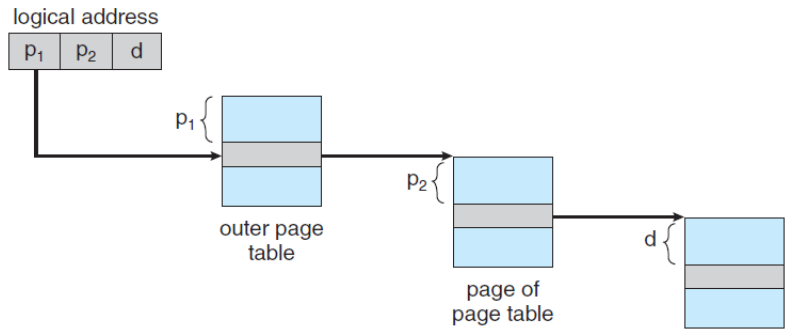
- Hierarchical Paging
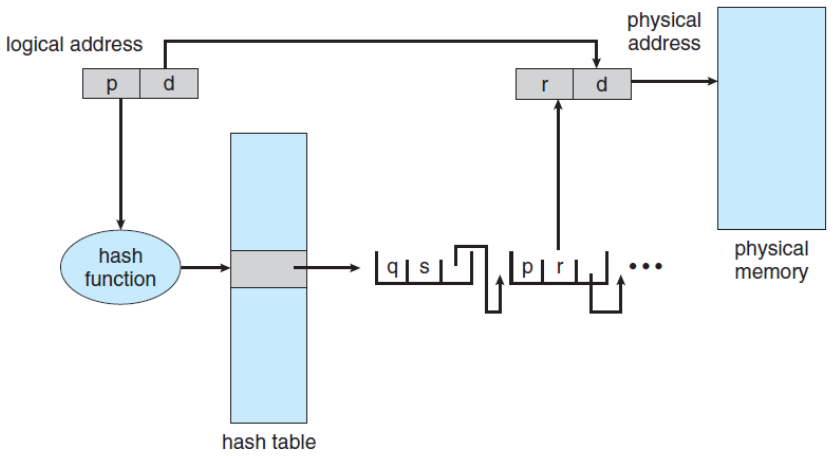
- Hashed Page Table
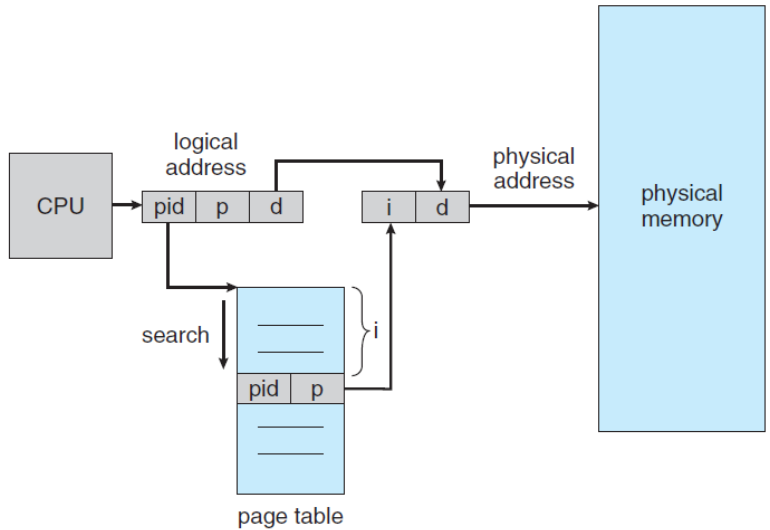
- Inverted Page Table
- It needs some techniques for structuring the page table.
Hierarchical Paging
- Breaks up the logical address space into multiple tables.
Hashed Page Tables
- Hashed Page Tables for handling address space larger than 32 bits, use a hashed table with the hash value being the virtual page number.
Inverted Page Tables
- Rather than having a page table, use an inverted page table one entry for each real page consisting of the virtual address with information about the process.
Swapping
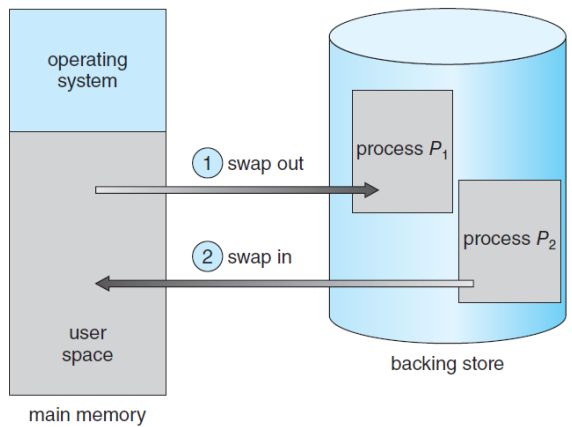
- Swapping makes it possible for the total physical address space of all processes to exceed the real physical memory of the system thus increasing the degree of multiprogramming in a system.
- Process instructions and data must be in memory to be executed.
- However, a process, or a portion of a process can be swapped temporally out of memory to a backing store and then brought back into memory for continued execution.
Standard Swapping
- Standard Swapping moves entire processes between main memory and a backing store.
- The cost of swapping entire processes is too prohibitive.
Swapping with Paging
- Pages of a process can be swapped instead of an entire process.
- This strategy still allows physical memory to be oversubscribed, but only a small number of pages will be involved in swapping.
- Today, paging refers to swapping with paging.
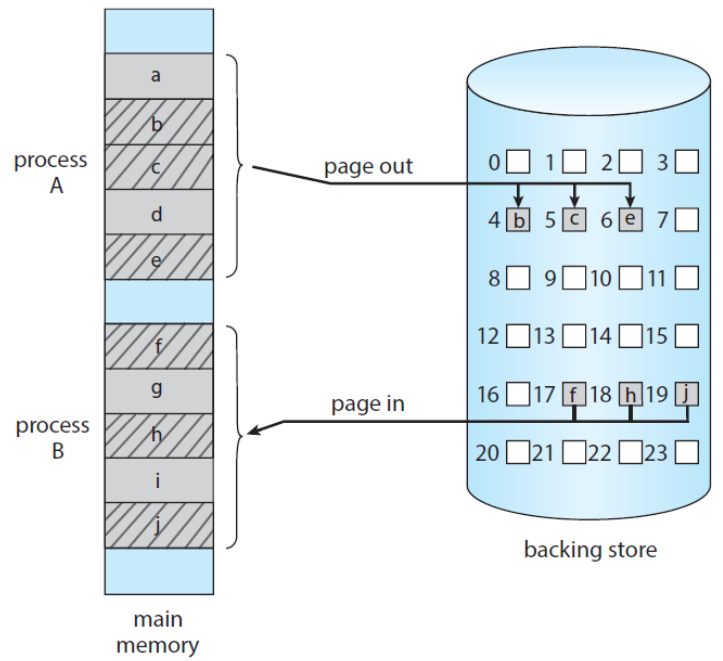
- page out: moves a page from memory to backing store.
- page in: moves a page from backing store to memory.
- Paging works well in conjunction with the virtual memory.