Overview
- A process is able to contain multiple threads of control.
- A thread is
- a lightweight process.
- a basic unit of CPU utilization.
- comprises a thread ID, a program counter, a register set, and a stack.
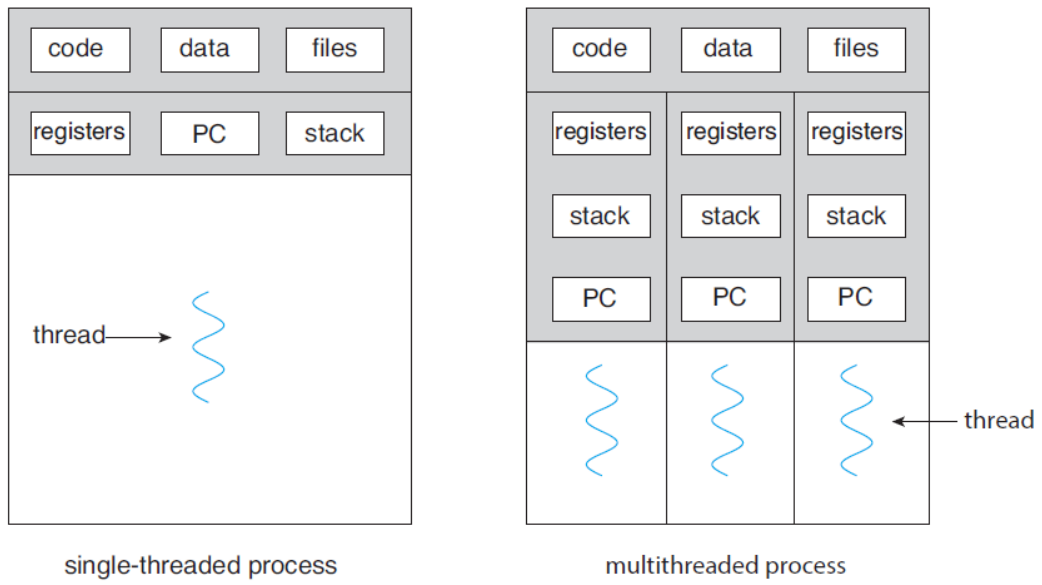
Multithreading
- Let us consider the case of client-server system, e.g., a web server.
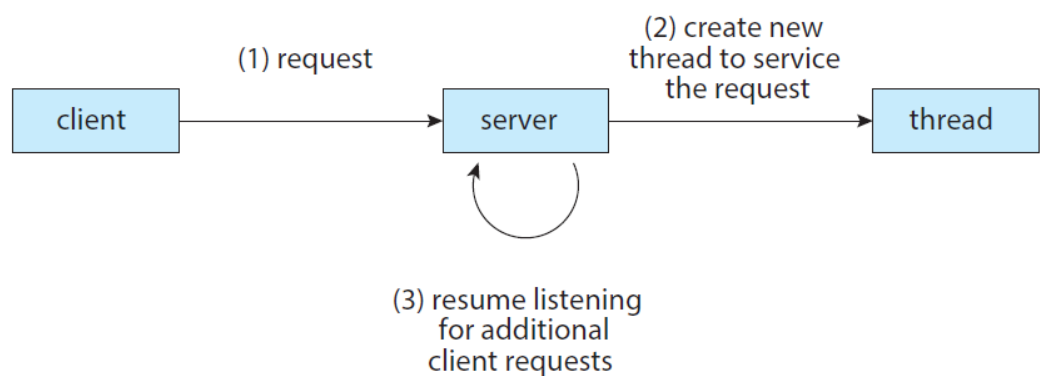
- The benefits of multithreaded programming:
- Responsiveness: may allow continued execution if part of process is blocked, especially important for user interfaces.
- Resource Sharing: threads share resources of process, easier than shared-memory or message-passing.
- Economy: cheaper than process creation, thread switching lower overhead than context switching.
- Scalability: process can take advantage of multiprocessor architectures
Thread Library in Java
In a Java program, threads are the fundamental model of program execution.
Java provides a rich set of features for the creation and management of threads
Three techniques for explicitly creating threads in Java.
Inheritance from the Thread class
- create a new class that is derived from the Thread class.
- and override its public void run() method.
class MyThread1 extends Thread {
    public void run() {
        try {
            while (true) {
                 System.out.println("Hello, Thread!");
                Thread.sleep(500);
            }
        }
        catch(InterruptedException ie) {
            System.out.println("I'm interrupted");
        }
    }
}

public class ThreadExample1 {
    public static final void main(String[] args) {
        MyThread1 thread = new MyThread1();
        thread.start();
        System.out.println("Hello, My Child!");
    }
}
- Implementing the Runnable interface.
- define a new class that implements the Runnable interface.
- and override its public void run() method.
class MyThread2 implements Runnable {
    public void run() {
        try {
        while (true) {
            System.out.println("Hello, Runnable!");
            Thread.sleep(500);
            }
        }
        catch (InterruptedException ie) {
            System.out.println("I'm interrupted");
        }
    }
}

public class ThreadExample2 {
    public static final void main(String[] args) {
        Thread thread = new Thread(new MyThread2());
        thread.start();
        System.out.println("Hello, My Runnable Child!");
    }
}
- Using the Lambda expression (beginning with Java Version 1.8)
- rather than defining a new class,
- use a lambda expression of Runnable instead.
public class ThreadExample3 {
    public static final void main(String[] args) {
        Runnable task = () -> {
            try {
                while (true) {
                    System.out.println("Hello, Lambda Runnable!");
                    Thread.sleep(500);
                }
            }
            catch (InterruptedException ie) {
                System.out.println("I'm interrupted");
            }
        };
        Thread thread = new Thread(task);
        thread.start();
        System.out.println("Hello, My Lambda Child!");
    }
}
- Process의 wait에 대응되는 개념으로 join 사용
- stop은 동기화 문제로 인해 사용하지 않고 대신 interrupt 사용
Multicore Programming
- Multithreading in a multicore system is more efficient use of multiple cores for improved concurrency.
- Consider an application with four threads.
- single-core: threads will be interleaved over time.
- multiple-cores: some threads can run in parallel.

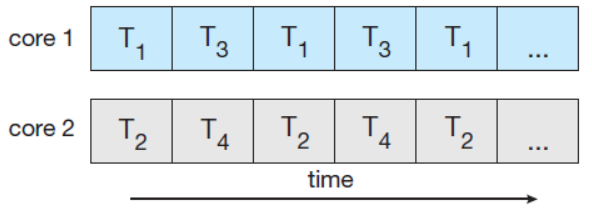
- Programming Challenges in Multicore systems.
- Identifying tasks: find areas can be divided into separate tasks.
- Balance: ensure the tasks to perform equal work of equal value.
- Data splitting: data also must be divided to run on separate cores.
- Data dependency: ensure that the execution of tasks is synchronized to accommodate the data dependency
- Testing and debugging: more difficult than single-thread.
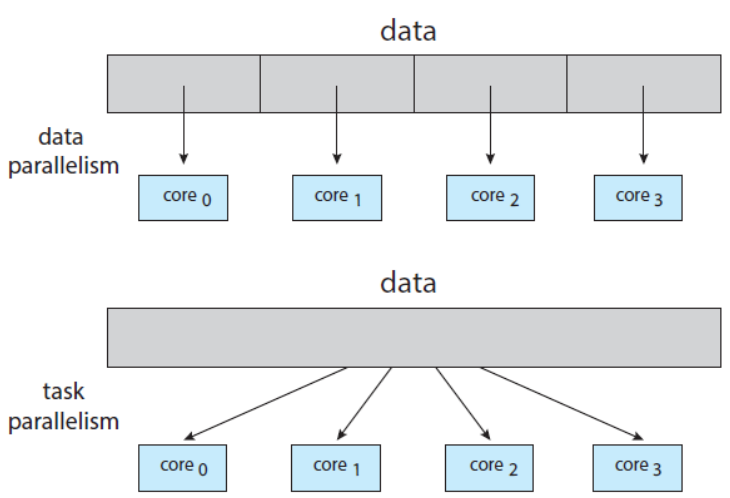
Types of parallelism
- 최근에는 분산 시스템의 발전으로 아래처럼 단순한 예시가 덜 의미있음
Amdahl’s Law
- $speedup <= \frac{1}{S +\frac{1 - S}{N}}$
- S: the portion that must be performed serially on a system
- N: the number of processing cores
Multithreading Models
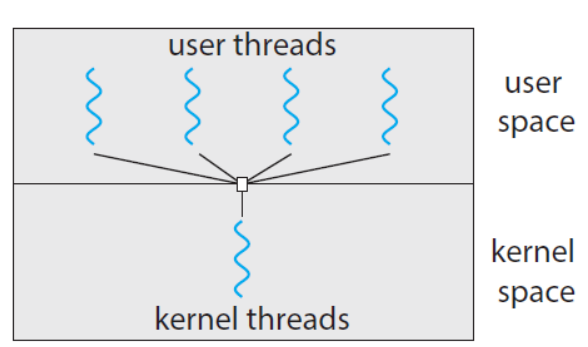
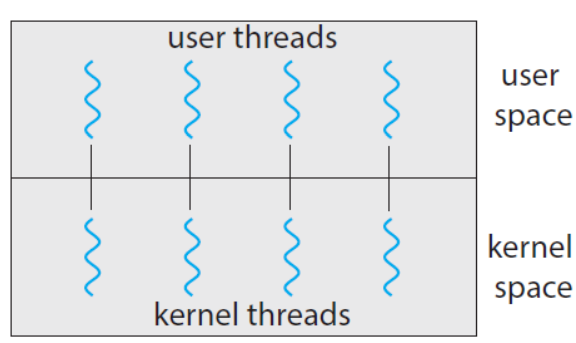
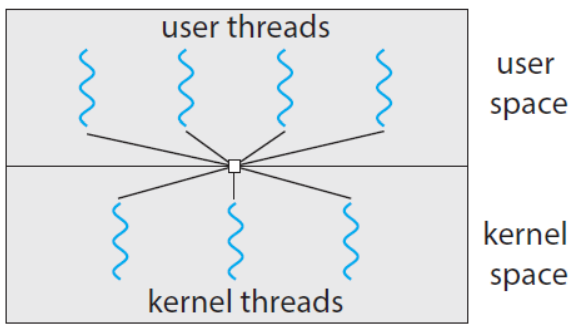
Two types of threads: user threads and kernel threads
- User threads are supported above the kernel, and are managed without kernel support.
- Kernel threads are supported and managed directly by the operating system.
Three relationships between user and kernel threads
Many-to-One Model
- One-to-One Model
- Many-to-Many Model
Thread Libraries
- A thread library provides an API for creating and managing threads.
- Three main thread libraries are in use today:
- POSIX Pthreads
- Windows thread
- Java thread
Pthreads
- Refers to the POSIX standard (IEEE 1003.1c)
- Just a specification for thread behavior, not an implementation
#include <stdio.h>
#include <stdlib.h>
#include <pthread.h>

/* the data shared by the threads */
int sum;
/* thread call this function */
void * runner(void *param);

int main(int argc, char *argv[])
{
    pthread_t tid; // thread identifier
    pthread_attr_t attr; // thread attributes

    pthread_attr_init(&attr);
    pthread_create(&tid, &attr, runner, argv[1]);
    pthread_join(tid, NULL);

    printf("sum = %d\n", sum);
}
void *runner(void *param)
{
    int i, upper = atoi(param);
    sum = 0;
    for (i = 0; i <= upper; i++)
        sum += i;
    pthread_exit(0);
}
#include <stdio.h>
#include <unistd.h>
#include <wait.h>
#include <pthread.h>

int value = 0;
void * runner(void *param);

int main(int argc, char *argv[])
{
    pid_t pid;
    pthread_t tid;
    pthread_attr_t attr;

    pid = fork();

    if (pid == 0) { // child process
        pthread_attr_init(&attr);
        pthread_create(&tid, &attr, runner, NULL);
        pthread_join(tid, NULL);
        printf("CHILD: value = %d\n", value); // LINE C
    }
    else if (pid > 0) { // parent process
        wait(NULL);
        printf("PARENT: value = %d\n", value); // LINE P
    }
}
void *runner(void *param)
{
    value = 5;
    pthread_exit(0);
}
Implicit Threading
The Strategy of Implicit Threading
- The design of concurrent and parallel applications, i.e., the design of multithreading in multicore systems, is too difficult for application developers.
- So, transfer the difficulty to compiler and run-time libraries.
Four alternative approaches using implicit threading:
- Thread Pools
- create a number of threads in a pool where they await work.
- Fork & Join
- explicit threading, but an excellent candidate for implicit threading.
- OpenMP
- a set of compiler directives and an API for programs written in C/C++.
- Grand Central Dispatch (GCD)
- developed by Apple for its macOS and iOS operating system.
- Thread Pools
OpenMP
- Identifies parallel regions as blocks of code that may run in parallel.
- Insert compiler directives into source code at parallel regions.
- these directives instruct OpenMP runtime library to execute the region in parallel.
#include <stdio.h>
#include <omp.h>

int main(int argc, char *argv[])
{
    #pragma omp parallel // compiler directive
    {
        printf("I am a parallel region.\n");
    }

    return 0;
}
#include <stdio.h>
#include <omp.h>

int main(int argc, char *argv[])
{
    omp_set_num_threads(4);

    #pragma omp parallel
    {
        printf("OpenMP thread: %d\n", omp_get_thread_num());
    }

    return 0;
}
#include <stdio.h>
#include <omp.h>

#define SIZE 100000000

int a[SIZE], b[SIZE], c[SIZE];

int main(int argc, char *argv[])
{
    int i;
    for (i = 0; i < SIZE; ++i)
        a[i] = b[i] = i;

    #pragma omp parallel for
    for (i = 0; i < SIZE; ++i) {
        c[i] = a[i] + b[i];
    }

    return 0;
}