Background
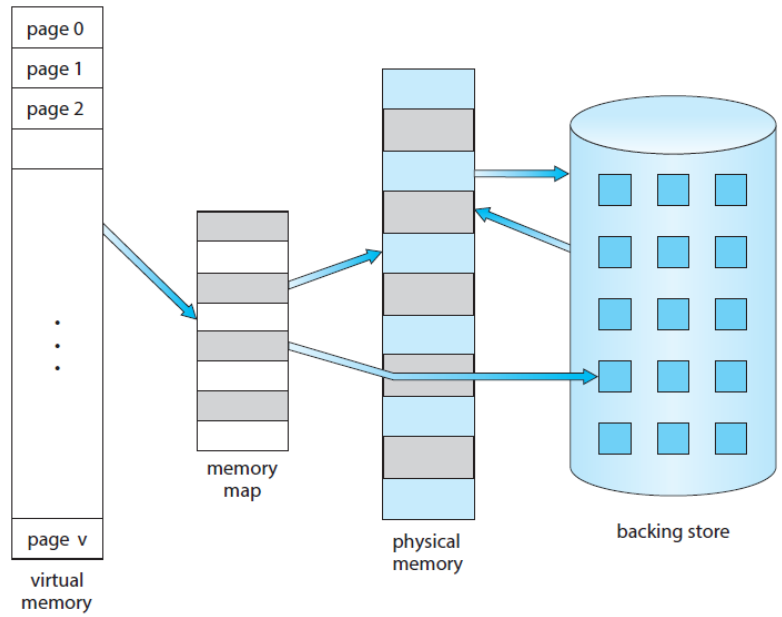
- Virtual Memory is a technique to allow the execution of processes that are not completely in memory so, programs can be larger than physical memory.
- Abstracts main memory into an extremely large array of storage, separating logical memory from physical memory.
- Provides an efficient mechanism for sharing files and libraries and process creation.
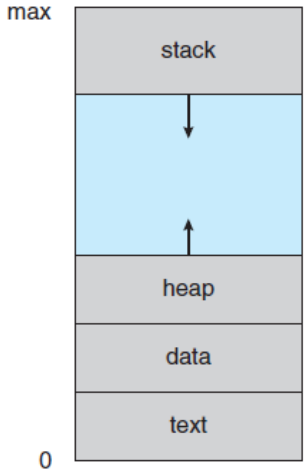
- Virtual Address Space is the logical (or virtual) view of how a process is stored in memory.
- Typically, begins a certain logical address, to say, address 0, and exists in contiguous memory.
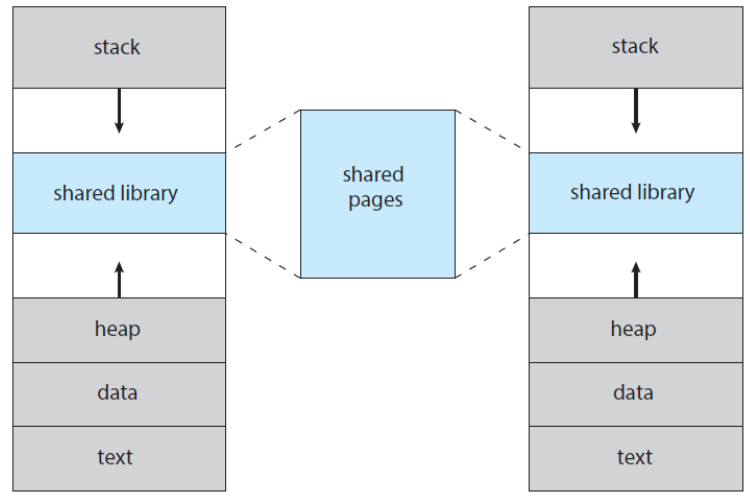
- Virtual Memory allows files and memory to be shared by two or more processes through page sharing.
Demand Paging
Consider how an executable program might be loaded from secondary storage into memory.
One option is to load the entire program in physical memory.
The demand paging is an alternative strategy to load pages only as they are needed.
- commonly used in virtual memory systems.
With demand-paged virtual memory, pages are loaded only when they are demanded during execution.
Basic Concepts of the Demand Paging
- While a process is executing, some pages will be in memory and some will be in secondary storage.
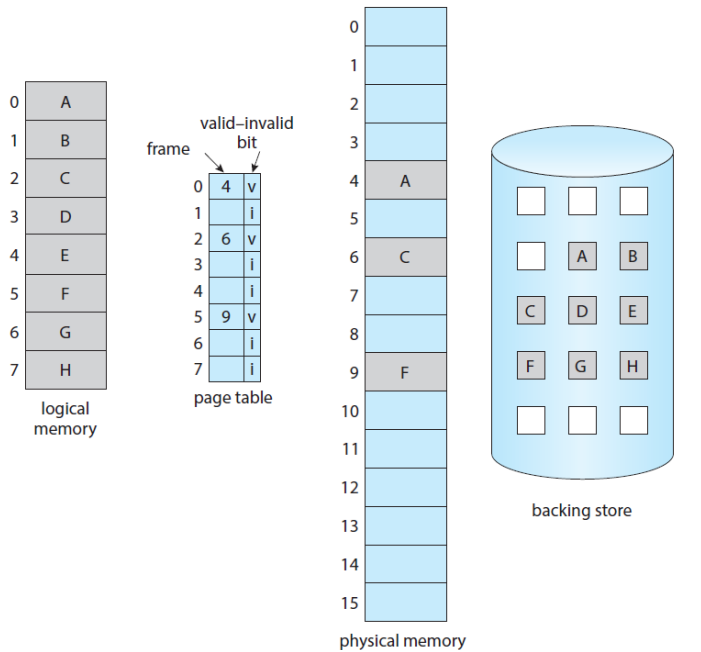
- To distinguish between these two situations, the valid-invalid bit scheme can be used.
- valid: the page is both legal and in memory.
- invalid: the either is not valid or currently in secondary storage.
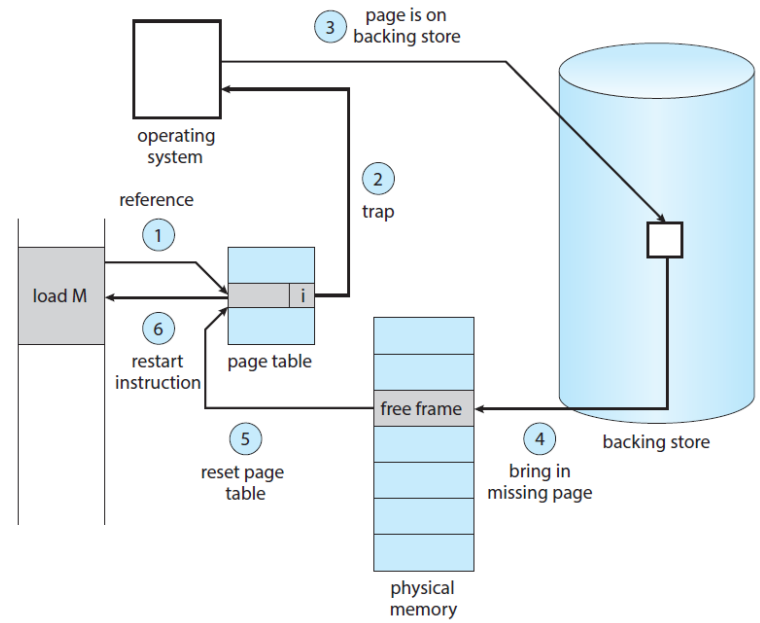
- The procedure for handling the Page Fault:
- Check an internal table for the process to determine whether the reference was valid or invalid memory access.
- If the reference was valid, terminate the process, or valid but page fault, we now page it in.
- Find a free frame (by taking one from the free-frame list)
- Schedule a secondary storage operation to read the desired page into the newly allocated frame.
- When the storage read is complete, modify the internal table and the page table to indicate that the page is now in memory.
- Restart the instruction that was interrupted by the trap.
Pure Demand Paging
- Never bring a page into memory until it is required.
- With the scheme of pure demand paging, we can start executing a process with no pages in memory.
- When the OS sets the instruction pointer to the first instruction of the process with a page fault, the page of the process would be paged in.
Locality of Reference
If a program accesses several new pages with each instruction, to say, one page for the instruction and many pages for data, possibly causes multiple page faults per instruction.
Fortunately, analysis running processes show that this behavior is exceedingly unlikely.
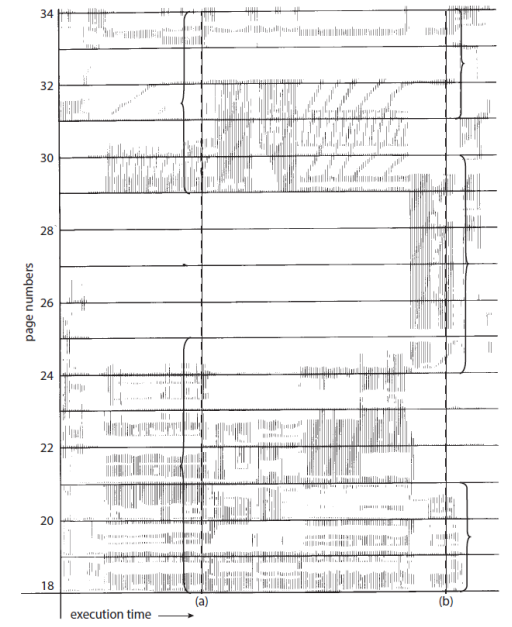
Programs tend to have the locality of reference, which results in reasonable performance from demand paging.
An Example of Program Structure
- Let the page size to be 128 and an array to be 128 × 128, then compare the following two codes.
- Careful selection of data structures and programming structures can increase the locality of code or data hence, lower the page-fault rate and enhance the system performance.
- 이론상, 2의 pagefault가 훨씬 적게 일어남
// 1
int i, j;
int[128][128] data;

for (j = 0; j < 128; ++j)
    for (i = 0; i < 128; ++i)
        data[i][j] = 0;

// 2
int i, j;
int[128][128] data;

for (i = 0; i < 128; ++i)
    for (j = 0; j < 128; ++j)
        data[i][j] = 0;
Hardware Support to Demand Paging
- Page table has the ability to mark valid or invalid. (with a valid-invalid bit)
- Secondary memory (=swap space) holds those pages that are not present in main memory.
- usually a high-speed disk or NVM device
Instruction Restart
A crucial requirement for demand paging.
- The ability to restart any instruction after page fault.
When the page fault occurs, the state of interrupted process (registers, condition code, instruction counter, etc.) is saved.
Therefore, restart the process in exactly the same place and state.
If a page fault occurs on the instruction fetch, restart by fetching the instruction again.
If a page fault occurs while we are fetching an operand, fetch and decode the instruction again and then fetch the operand.
As a worst-case example
- ADD A, B, C; three address instruction, adding A and B into C.
- Fetch and decode the instruction (ADD)
- Fetch A
- Fetch B
- ADD A and B
- Store the sum in C
- ADD A, B, C; three address instruction, adding A and B into C.
Free Frame List
- When a page fault occurs, OS must bring the desired page from secondary storage into memory.
- To resolve page faults, OS maintains the free frame list: a pool of free frames for satisfying such requests.
- Free frames must also be allocated when the stack or heap segments from a process expand.

Performance of Demand Paging
How to compute the effective access time for a demand-paged memory?
Let ma to denote the memory-access time.
Let p be the probability of a page fault.
- EAT = 1 − 𝑝 × 𝑚𝑎 + 𝑝 ∗ (𝑝𝑎𝑔𝑒 𝑓𝑎𝑢𝑙𝑡 𝑡𝑖𝑚𝑒).
How much time is needed to service a page fault?
- three major activities:
- Service the page-fault interrupt.
- Read in the page.
- Restart the process
- three major activities:
Consider a system with an average page-fault service time of 8 milliseconds
- and a memory access time of 200 nanoseconds,
- EAT = (1 − 𝑝) × 200 + 𝑝 × 8,000,000 = 200 + 7,999,800 × 𝑝
If one access out of 1,000 causes a page fault (𝑝 = 0.001),
- EAT = 200 + 7999.8 = 8199.8 nanoseconds ≅ 8.2 microseconds
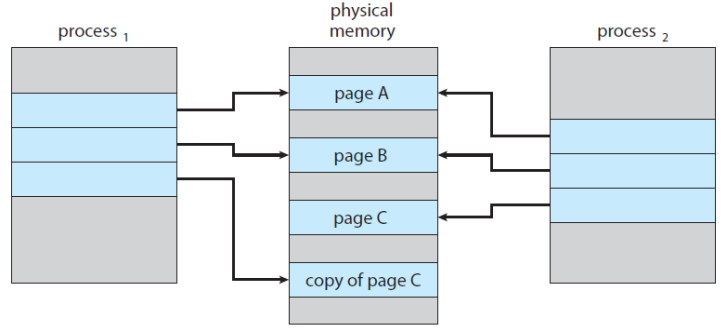
Copy-on-Write
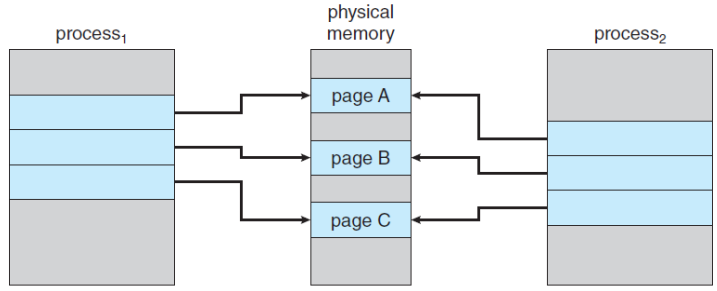
- Copy a shared page only when a process writes to a shared page.
- Recall the process creation with fork() and exec().
Page Replacement
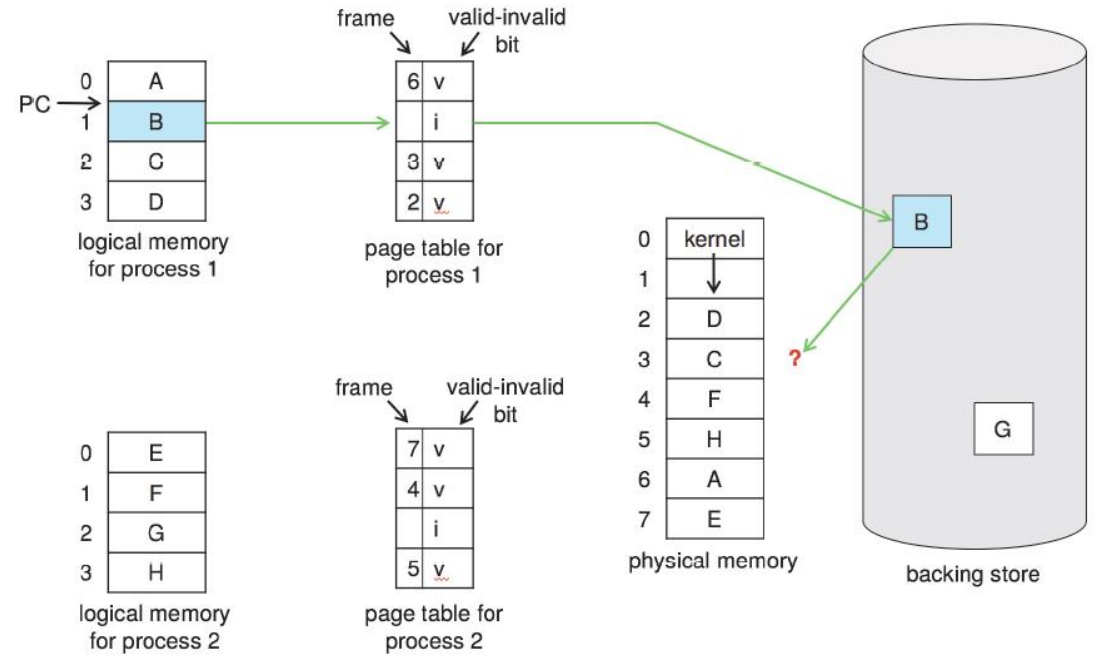
- What happens if there is no free frames?
- If we increase our degree of multiprogramming, we are over-allocating memory.
- If we have 40 frames and run 6 processes, each of which is 10 pages in size, but actually uses only 5 pages.
- Then, we manage to demand-paged system with 10 frames spared.
- However, what if the processes suddenly want to use all 10 pages, or need a huge buffer consuming more pages than available ones?
- Page Replacement
- If no frame is free, find one that is not currently being used and free it.
- Free a frame by writing its contents to swap space and changing the page table to indicate that the page is no longer in memory (invalid or dirty).
- Now, use the freed frame to hold page for which the process faulted.
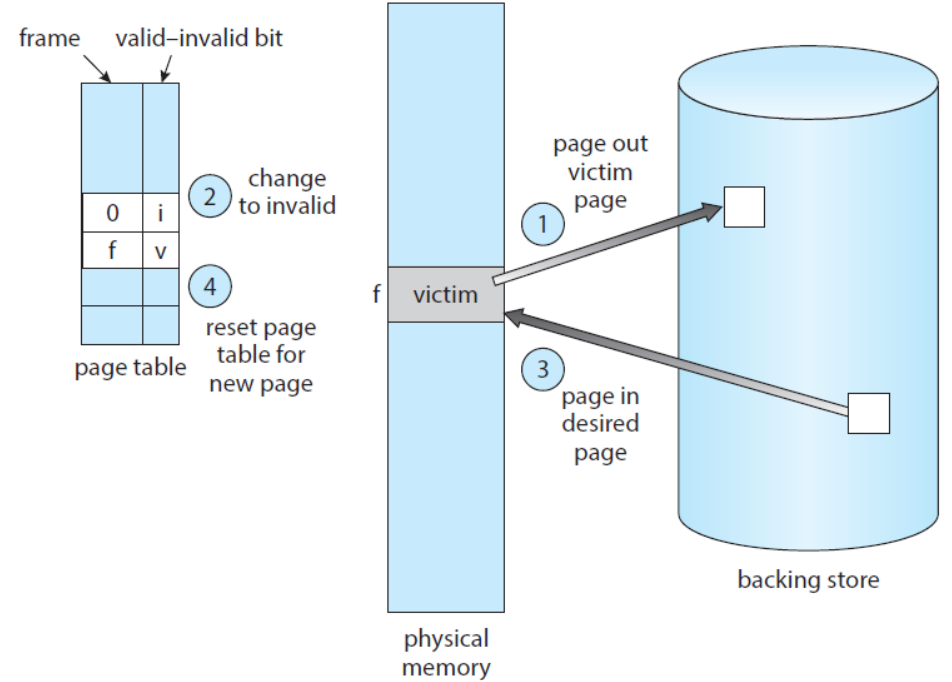
Page Fault Service Routine includes Page Replacement
- Find the location of the desired page on secondary storage.
- Find a free frame.
- If there is a free frame, use it.
- If there is no free frame, use a page-replacement algorithm to select a victim frame.
- Write the victim frame to secondary storage; change the page and frame tables accordingly.
- Read the desired page into the newly freed frame change the page and frame tables.
- Continue the process from where the page fault occurred.
Two major problems to implement demand paging
- Frame-allocation algorithm: how many frames to allocated to each process?
- Page-replacement algorithm: select the frames that are to be replaced.
- Since the secondary storage I/O is so expensive, even slight improvements in demand-paging methods can yield large gains in system performance.
Evaluation of Page Replacement Algorithms
- reference string: a string of memory references.
- Evaluate an algorithm by running it on a reference string and computes the number of page faults. (minimize it!)
- What about the number of page frames?
- Obviously, the more frames, the less page faults.
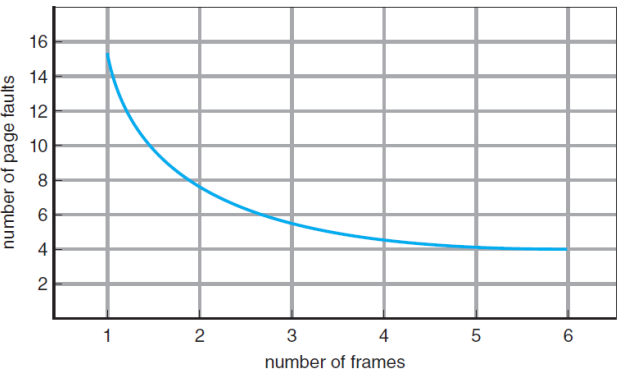
- An example to evaluate algorithms:
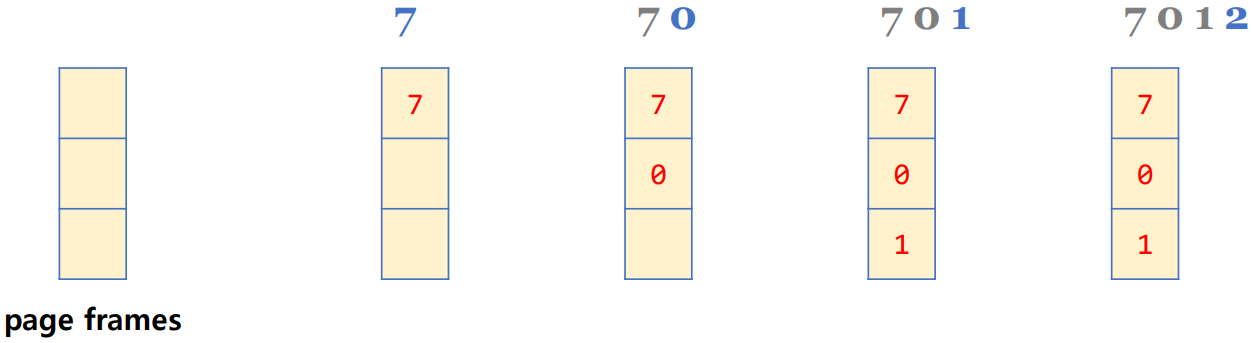
- reference string: 7 0 1 2 0 3 0 4 2 3 0 3 0 3 2 1 2 0 1 7 0 1 in a memory with three frames.
- 2가 도착했을 때, 7 0 1 중에 누구와 교체할 것 인가?
FIFO Page Replacement
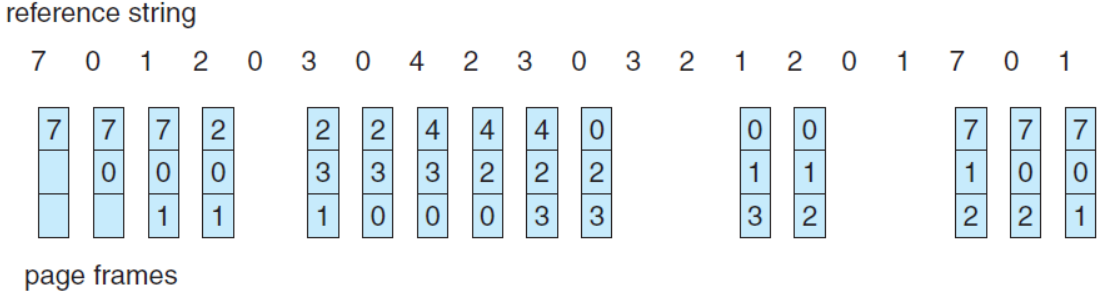
- FIFO: First-In-First-Out: the simplest algorithm.
- Choose the oldest page when a page must be replaced.
- There are 15 page faults with our example.
Belady’s Anomaly
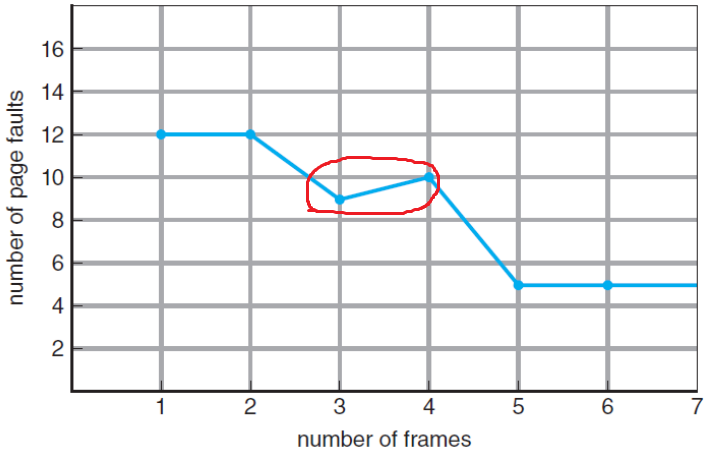
- The page-fault rate may increase as the number of allocated frames increases.
- e.g. • reference string: 1 2 3 4 1 2 5 1 2 3 4 5
Optimal Page Replacement
Seeking for an optimal algorithm that has the *lowest page-fault rate, and never suffers from Belady’s anomaly.
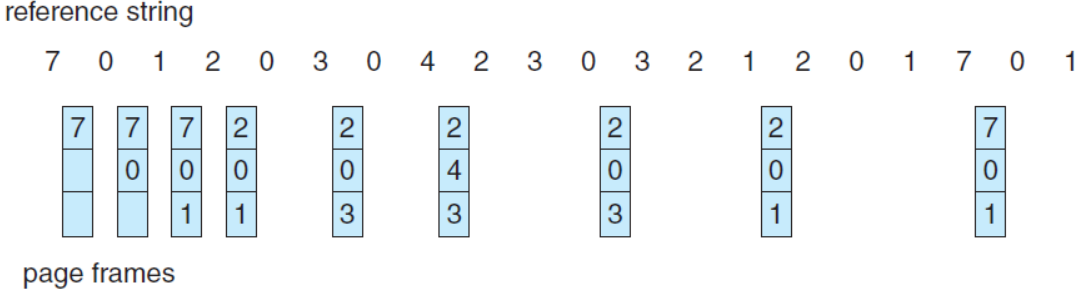
OPT or MIN: replace the page that will not be used for the longest period of time.
OPT will guarantee the lowest possible page-fault rate.
The difficulty of implementing OPT
- There are 9 page faults with our example.
- OPT requires future knowledge of the reference string.
- used mainly for comparison studies.
LRU Page Replacement
Recall the Shortest-Job-First CPU scheduler.
- The key distinction between the FIFO and the OPT:
- looking backward: when a page was brought in?
- looking forward: when a page to be used?
- If we use the recent past as an approximation of the near future, then we can replace the page that has not been used for the longest period of time.
- The key distinction between the FIFO and the OPT:
LRU: Least Recently Used
Associates with each page the time of that page’s last use, and choose the page that has not been used for the longest period of time.
Locality of reference 관점에서 보면, 합리적일 수 있는 방법.
There are 12 page faults with our example.
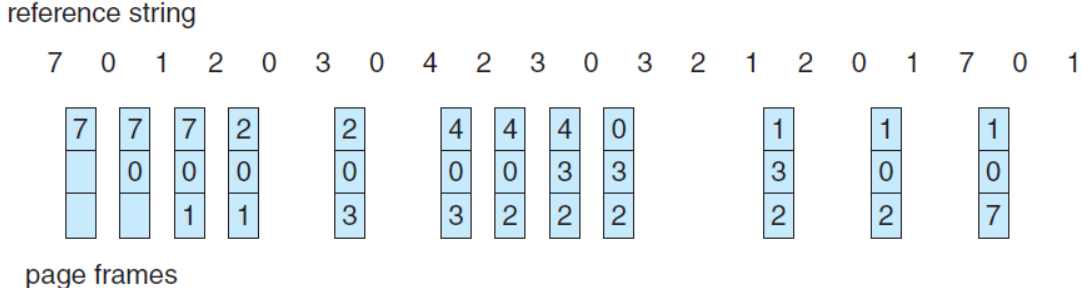
LRU policy is considered to be good and is often used.
However, the problem to solve for the implementation of LRU is to determine an order for the frames defined by the time of last use?
It may require substantial hardware assistance.
- Two implementations are possible: counter and stack.
LRU does not suffer from Belady’s anomaly like OPT.
Two implementation methods for the LRU
- Counter implementation
- Whenever a page is referenced, copy the counter (or the clock).
- Replace the page with the smallest value.
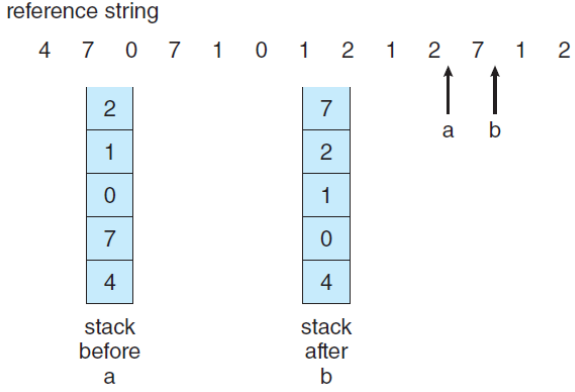
- Stack implementation:
- Keep a stack of page numbers.
- Note that entries must be removed from the middle of the stack.
- Counter implementation
- LRU-Approximation
- LRU needs hardware support, however, many systems provide some help with a reference bit.
- reference bit: initially 0, a bit associated with each page.
- when a page is referenced, set to 1.
- replace any with reference bit = 0 (if any).
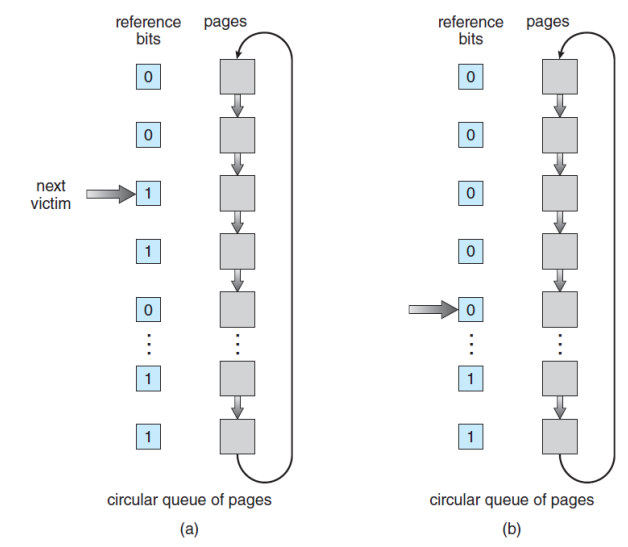
Second-Chance Algorithm
- Use a FIFO replacement algorithm.
- However, inspect its reference bit, when a page has been selected.
- If the value is 0, proceed to replace it.
- If the value is 1, give the page a second change and move on to select the next FIFO page.
- When a page gets a second chance, its reference bit is cleared, and its arrival time is reset to the current time.
Allocation of Frames
- The Issues for Frame Allocation
- Consider a simple case of a system with 128 frames.
- OS may take 35, leaving 93 frames for the user process.
- Using the pure-demand-paging, 93 frames would be put on the free-frame list.
- The first 93 page faults would get free frames.
- 94th page faults would cause a page replacement.
- Then, if we have two processes, how do we allocate 93 frames to these two processes?
- Consider a simple case of a system with 128 frames.
- The strategies for frame allocation
- Equal .vs. Proportional
- equal allocation: give every process an equal share.
- proportional allocation: allocate according to the size of process.
- Global .vs. Local:
- local replacement: selects from only its own set of allocated frames.
- global replacement: selects a replacement frame from the set of all the frames in the system.
- Equal .vs. Proportional
Thrashing
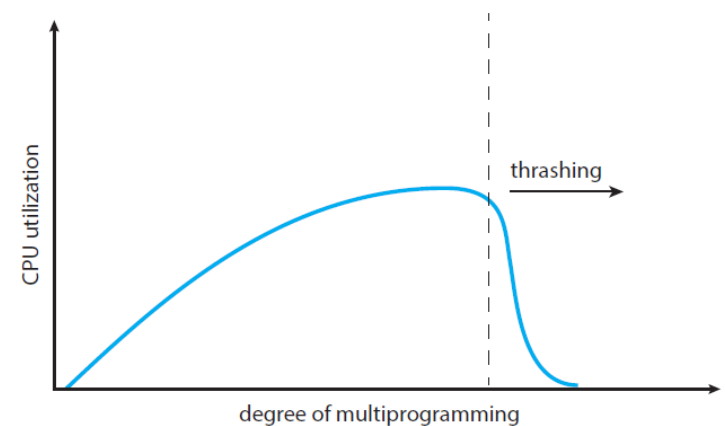
- Thrashing is a situation that a process is busy swapping pages in and out.
- If a process does not have enough pages, the page-fault rate is very high.
Working-Set Model
- Based on the assumption of locality.
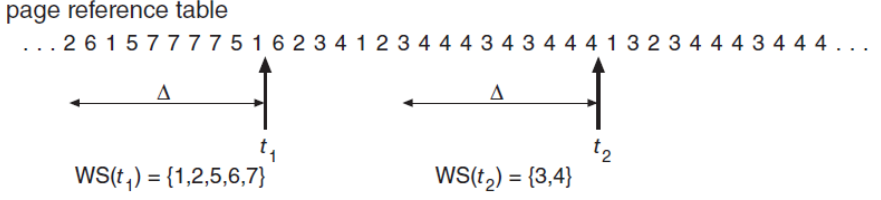
- Define the working-set window with a parameter $\Delta$.
- The idea is to examine the most recent $\Delta$ page references.
- working-set: the set of pages in the most recent $\Delta$ page references.
- If a page is in active use, it will be in the working set.
- If it is no longer being used, it will drop from the working set time units after its last reference.